ERIC KRAUSE
In
business since 1996
- © Krause House
Info-Research Solutions -
ERIC KRAUSE REPORTS
MY HISTORICAL REPORTS
PUBLISHED ON THE INTERNET
BACK TO KRAUSE REPORTS or BACK TO KRAUSE RESEARCH TRIPS
MAJOR UNITED STATES RESEARCH TRIPS SERIES
RESEARCH TRIP ~ HISTORIC ROUTE 66
Friday, March 16, 2007 - Sunday, April 22, 2007
A HISTORY OF THE VITRIFIED BRICK ROAD
THE MOTHER ROAD
(2249.1 Miles)
Route 66: A History of the Vitrified Brick Road
By Eric Krause, October 21, 2007
(Krause House Info-Research Solutions)
HISTORY
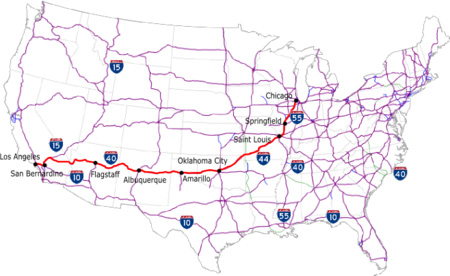
Route 66 (U.S. Highway 66 1926-1984), extending from Chicago to Los Angeles, through eight states, was not completely paved until 11 years after named. For example:
It was the intent of highway designers to make Route 66 "modern" in every sense of the term. State engineers worked to reduce the number of curves, widen lanes, and ensure all-weather capability. Until 1933 the responsibility to improve existing highways fell almost exclusively to the individual states. The more assertive and financially prepared states met the challenge. Initial improvements cost state agencies an estimated $22,000 per mile. In 1929 Illinois boasted approximately 7,500 miles of paved roads, including all of its portion of U.S. Highway 66. A Texaco road report published that same year noted the route fully concreted in Kansas, 66% paved in Missouri, and 25% improved in Oklahoma. In contrast, the 1,200-mile western stretch (with the exception of California's metropolitan areas) never saw a cement mixer. Until the height of the Great Depression, Texas, New Mexico, Arizona, and the desert communities of southeast California collectively totaled only 64.1 miles of surfaced highway along Route 66 ... [http://www.route66patrol.com/history3.htm]
After the influx of federal money into road construction in the 1920s, 23 percent of the highways in the United States had been surfaced by 1930. However, most of the surfacing was macadam or gravel, and only 3 percent of the total mileage had been surfaced with concrete, asphalt, or brick ... While the 1920s witnessed road construction and route consolidation, the 1930s brought both asphalt and concrete to America’s roads. As a typical example, the route of U.S. Highway 66 had been determined by 1926, but the last 4-mile stretch did not receive asphalt paving until 1937 ..... [Arizona Highways]
Portions were classic macadamized (three compacted layers of interlocked, angular stones laid on a crowned subgrade with side drainage ditches invented in 1820), or tarred-bound (sprayed tar, i.e. tarmac) macadamized, or of concrete, or of vitrified clay paving brick (also known as blocks or pavers). Larger and heavier than a conventional brick, they tended to stay in place.
At first, the base for bricks was sand, but this failed as traffic got heavier, or in climates of severe freeze-thaw that caused the bricks to heave. Later, most often the base was concrete.
Glazed at temperatures high enough to fuse grains and close the surface pores, vitrified bricks were dense, impervious to water, highly resistant to chemical corrosion, with a crushing strength of eight to ten thousand pounds per square inch. After fired in the kiln, they cured from seven to ten days to produce this strength.
Rural brick highways in the United States were not unique to Route 66, and indeed pre-dated it by many years. For example, in the United States, the first rural brick road dates to the fall of 1893. It, at a cost of $16,000 per mile, was the Wooster Pike, near Cleveland, in Ohio. [Butler; http://www.fhwa.dot.gov/administrators/mdodge.htm .
The first brick road in an urban area was in Charleston, West Virginia, in 1870. On Route 66, an excellent example of an urban setting with at least side streets, paved in the late 1800s, of original brick, was Bristow, Oklahoma.
Extant portions of rural brick roads still remain on the 1913 Lincoln (New York to San Francisco) and 1915-1927 Dixie (Chicago/Sault Ste. Marie to Miami) Highway systems which in turn consisted of earlier roads.
However the popularity of bituminous macadam (introduced 1906) and concrete (introduced 1909) for American roads quickly supplemented brick such that by the 1930s, it was no longer generally in use there. By then the proliferation and higher speed of automobiles, the requirement of more and better roads, the need for smoother riding highways, and the demand for road types laid faster and cheaper than brick, had won the day.
Vitrified brick production peaked in c. 1909. Although in 1915 one of the leading manufacturers of street and highway vitrified bricks was in Illinois (a Route 66 state), the leading States with brick highways in 1925 were Ohio (the leader by far), Pennsylvania, and Florida. Nevertheless, the total number miles of rural brick roads nation wide was never substantial, for example, in c. 1925, only 3,111 miles. [http://www.flaglercounty.org/brickrd/brick.htm].
These early successes led many other firms to begin manufacturing paving block in Ohio. By 1893, 44 separate firms were producing bricks for paving, and 357 kilns were being used exclusively for pavers. The annual production of paving brick in Ohio in 1893 was 292 million blocks. To put this in perspective, it required approximately one half million blocks to pave 1 mile of road 25 feet wide, Thus, there were enough pavers produced annually to pave nearly 600 miles of road. [Blakenbeker, p. 4]
The process for building rural brick highways in the early twentieth century consisted of a series of steps carried out in succession. After an alignment was selected and cleared of vegetation and roots, the subgrade was moistened, packed, and rolled for firmness and uniformity, generally with a ten-ton roller. Then the curbing was laid in gravel or broken stone beds about three inches thick. Road foundations for heavy traffic areas were often poured concrete slabs; in areas with light traffic a subgrade might consist of broken stone or a gravel-sand composite rolled with a ten-ton roller. The majority of vitrified bricks manufactured by the nation’s brick companies measured 3.5 inches by 4 inches by 9 inches. They were laid in uniform courses at right angles to the curbs as close as possible and crowded together by means of a crowbar inserted at the curb (Figure 17). After the highway was laid, the pavement was swept clean and smoothed with rollers weighing between three and five tons to eliminate irregularities. Various grouts, including Portland cement, sand, or bituminous materials, were often employed to help keep the bricks in their proper position and to protect the edges from chipping and spalling. Some roads were built with expansion joints. In this process, pieces of lumber ranging between three-eighths to one inch in thickness were laid with metal removal straps inside the curbs. Once the bricks were laid and rolled, the expansion joints were removed ...
[http://www.flaglercounty.org/brickrd/bricks.pdf].In 1913, Vernon Peirce [Vernon M. Pierce - Chief of Construction)] and Charles H. Moorefield [Senior Highway Engineer]of the Bureau of Public Roads published one of the nation’s most comprehensive studies on brick paving for rural roads. Pierce and Moorefield found that vitrified bricks were (1) durable under heavy traffic conditions; (2) afforded easy traction and good footing for horses; (3) were easily maintained and kept clean; and (4) presented a pleasing appearance. They asserted that the essential features of well-built brick roads consisted of a subgrade with thorough drainage, firmness, uniformity in grade and cross section, and adequate shoulders. Common curb materials included stone, Portland cement, or vitrified clay shapes made for the purpose with a depth of eighteen to thirty-six inches, four inches thick, and seven to eight feet in length. The typical rural brick highway was paved with vitrified bricks that each measured 3.5" x 4" x 9", weighed approximately nine pounds, forty-five to the square yard, and 237,600 per mile ... [http://www.flaglercounty.org/brickrd/bricks.pdf ].
"(1) They are durable under practically all traffic conditions; (2) they afford easy traction and moderately good foothold for horses; and (3) they are easily maintained and kept clean." ...."Since brick pavements are probably more expensive to construct than any other type of pavement at present used for country roads, it is all the more important that their construction should be carefully planned and well executed." [Pierce and Moorefield].
According to Blankenbaker:
Paving brick had to be compacted to a higher density than a pressed firebrick. Paving bricks commonly were extruded to roughly the finished size and then "re pressed" to square up the brick and further increase the density. Re pressing allowed the manufacturer to "brand" the brick impress the company's name on it. Because nearly all repressed pavers were branded, today we can still identify the manufacturer. Re pressing also allowed the brickmaker to produce either lugs (small knobs at the corners of the face) or raised lettering on the brick. When the bricks were laid, these raised areas kept the bricks spaced apart just enough to allow, pitch or sand to be introduced between them to help secure the roadbed. Grooves commonly were added to the back of the bricks for the same purpose. It was much easier to put lugs on a brick than raised lettering, so manufacturers apparently abandoned raised letters shortly after the turn of the century. Thus, a paver that has raised letters is generally an older type. Many companies produced extruded pavers and by passed the pressing operation. These common pavers generally bear no brand, unless a manufacturer rolled the brand on the edge or end of the brick. There is no way to know the manufacturer of most impressed bricks.
There were a few specialty types of pavers. A "hill" block has a beveled edge on one face that gave a horse a secure foothold on slopes. "Rail" blocks were used wherever a road traversed railroad tracks, allowing brick to be laid right up to the rails. "Depot" or sidewalk blocks were a thinner, vitrified paver that would still resist weathering. Some oversized blocks 5 inches in height were produced. It is hard to imagine mass producing these exceptionally large bricks ... [Blankenbaker, p. 3)].
Mentioned in assorted documents was a variety of sizes and weights: 3.5 inches by 4 inches by 9 inches, 3.5 inches by 4 inches by 8.5 inches, 4 inches by 4 inches by 9 inches, 3.5 inches by 5 inches by 10 inches (weighs 15 pounds), and even 2.5 inches by 4 inches by 8 1/2 inches for an 1885 firing [Blankenbaker, pp. 1-3)].
In 1914, the National Paving Brick Manufacturers Association issued a significant report title: "Specifications for the construction of vitrified brick street pavements and vitrified brick highways " where the complete report is available. It discusses the paving of both urban streets ("Specifications for the Construction of Vitrified Brick Street Pavements" ) and rural roads ("Specifications for the Construction of Vitrified Brick Highways"). The following is an extract from the second section, that on rural roads:
_____________________________
Specifications for the Construction of Vitrified Brick Highways
GRADING
Section 1. The road bed will be considered as that portion of the road upon which the base of the brick roadway and edging is laid and also that portion of the roadway upon which the crushed stone shoulders or berms and side roads are to be constructed. All of which is to be improved including the approaches thereto, and graded and drained to such grades, sub-grades and cross-sections as are shown by the plans of the engineer.
Earth in Excavation
Section 2. Earth in excavation shall be removed with plow and scraper or other device to such a depth as when rolled will conform to the true sub-grade. (The roller for this purpose should be three wheeled, self- propelling and should weigh not less than six nor more than ten tons.) Excess of material from excavations beyond that which is necessary to be used in embankment may be wasted in widening the roadway.
Earth in Embankment
Section 3. Earth in embankment must be applied in layers not more than six (6) inches in thickness, and each layer shall extend entirely across from the toe of the slope on one side to the toe of the slope on the other side, and each layer shall be thoroughly rolled ; all spongy and soft earth that cannot be made firm by rolling shall be removed and replaced with suitable material. Careful attention should be given to bring the entire sub- grade to a uniform density.
If insufficient material for embankment is obtained from the section of the roadway where materials must be excavated, then additional material for embankment will be secured from borrow pits the location of which is shown on plans.
Protection of Sub-Grade
Section 4. After the roadbed or foundation has been completed ready for the pavement, no loaded or empty wagons or other vehicles that might disturb the finished surface shall be permitted thereon, unless the surface is properly protected.
DRAINAGE
Drainage
Section 5. Drainage should be provided sufficient to rapidly remove all water from the roadway to a depth of not less than eighteen (18) inches below its finished surface.
CONCRETE EDGING
Concrete Edging
Section 6. At either edge of the brick work shall be placed an edging ........... inches in thickness and inches in depth.
Composition
Section 7. The concrete for the edging shall be composed of the kind of aggregate specified herein for the base. It shall be thoroughly mixed in a batch mixer and so proportioned that ......... cubic feet of the concrete in place shall contain ninety-four (94) pounds of cement. The concrete shall be placed between the forms which have heretofore been set true to grade and alignment and held securely in place by stakes and clamps. The concrete shall be tamped until the mortar flushes against the form and to the surface. The upper surface of the edging shall then be finished by scouring with a wood float. The edging shall, upon completion, be kept covered for not less than ....... days to prevent too rapid drying.
Section 8. During or after the construction of the road bed, earth side roads and berms shall be constructed. They shall be made true to the alignment and cross-section shown on the plans. The earth side roads shall be thoroughly rolled. No material containing weeds, roots or decomposed vegetable matter shall be used in the construction of the earth side roads. If macadam shoulders are provided on the plans, the earth side roads shall be rolled before or during the rolling of the macadam shoulders.
Section 9. In filling hillside embankments where the fill exceeds two feet the surface should be thoroughly broken up and steeped. No material containing roots, stumps or decomposed vegetable matter shall be used in the construction of any part of the road bed or allowed to remain within two (2) feet of the surface thereof.
CONCRETE FOUNDATION
Cement
Section 10. Cement used in the work shall meet the requirements of the Standard Specifications for Portland Cement of the American Society for Testing Materials, adopted August 16, 1909, with amendments and additions thereto adopted by said Society.
Water
Section 11. Water used in mixing the concrete shall be clean, free from oil, acid, strong alkalies or vegetable matter.
Fine Aggregate
Section 12. Fine aggregate shall consist of screenings from hard durable sand, gravel, granite or other hard rock and must not contain more than five (5) per cent of clay. It shall be reasonably uniformly graded from a size which will pass through a one-fourth (1/4) inch screen down. Sand containing disintegrated shale or slate shall not be used.
Coarse Aggregate
Section 13. Coarse aggregate shall consist of sound gravel, stone, vitrified clay or slag. It shall be free from all foreign matter, uniformly graded, and shall range in size from one-fourth (1/4) inch up to that which will pass a one and one-half (1 1/2) inch revolving screen.
Concrete Proportions
Section 14. The cement and aggregate shall be measured separately and then mixed in such proportions that the resulting concrete shall contain fine aggregate amounting to one-half (1/2 ) of the volume of the coarse aggregate, and that ........ cubic feet of the concrete in place will contain ninety-four (94) pounds of cement.
Mixing
Section 15. The ingredients of the concrete shall be thoroughly mixed, sufficient water being added to obtain the desired consistency, and the mixing continued until the materials are uniformly distributed, and each particle of the fine aggregate is thoroughly coated with cement and each particle of coarse aggregate is thoroughly coated with mortar. A batch concrete mixer must be used, the materials must be proportioned dry, and then deposited in the mixer all at the same time. The mixer must produce a concrete of uniform consistency and color, with the stones thoroughly mixed with the water, sand and cement.
Consistency
Section 16. The materials shall be mixed wet enough to produce a concrete of a consistency which can be handled without causing a separation of the coarse aggregate from the mortar while being spread into position with a template, straight edge or back of a shovel.
Precautionary Measures
Section 17. Retempering, that is, remixing with additional water, mortar or concrete that has partially hardened, shall not be permitted. No concrete shall be mixed while the air temperature is below 32 degrees F. except with the consent of the engineer.
Placing Concrete
Section 18. The concrete shall be deposited in a layer on the sub-grade in such quantities that it will be of the required thickness and the upper surface shall be smooth, true, uniform and parallel with the surface of the finished pavement and must not exceed a limit of one-half (1/2) inch from the true surface. In conveying the concrete from the place of mixing to the place of deposit, the operation must be conducted in such a manner that no mortar will be lost and the concrete must be so handled that the foundation will be of uniform composition throughout, showing no excess or lack of mortar in any place. If the sub-grade is exceedingly dry it shall be moistened.
Thickness
Section 19. This foundation shall be ......... inches in thickness, with its upper surface finished to inches below the grade of the finished pavement.
Protection
Section 20. When complete, the foundation shall be kept moist for not less than two (2) days. No loaded or empty wagons or other vehicles that might disturb the finished surface shall be permitted thereon, unless the surface is properly protected.
CUSHION
Character of Material
Section 21. Upon the foundation shall be spread a cushion which will be one and one-half (1/2) inches in depth after the same has been thoroughly and firmly compacted by rolling. The material for this cushion shall consist of granulated slag, stone dust, or a loamy sand which will firmly compact by rolling and must pass a quarter (1/4) inch screen.
How Spread and Prepared
Section 22. The cushion must be carefully shaped to a true cross-section, parallel with the finished roadway, by means of a template covering at least one-half (1/2) of the width of the brick work, and so made as to be easily drawn over the curb or guide rail. Guide timbers shall be one and one-half (1 1/2) inches by four (4) inches, and not less than fourteen (14) feet in length, and laid to a true line parallel with the grade in the center of the street and next to the curb (if top of curb cannot be used). Before shaping the cushion, a one-half (1/2) inch strip shall be laid on the curb or guide rail and strip of same thickness laid on guide timbers in the center of street, and a template drawn over the same leaving the cushion complete in place one-half (1/2) inch above the surface required, after which the one-half (1/2) inch strip shall be removed and the surface rolled thoroughly with a hand roller. After rolling, the template shall be drawn over the curb and guide timbers to complete the cushion. If the cushion should not be uniformly compacted and parallel to the surface of the finished pavement, the operations shall be repeated. The operations of shaping the foundation for the pavement and of compressing and shaping the cushion for the brick are considered of prime importance in securing the desired evenness in the surface of the finished pavement, and the contractor will be required to equip himself with the proper implements approved by the engineer and to secure skilled men for this part of the work. The roller for rolling the cushion shall weigh not less than ten (10) pounds per inch in length and should be approximately twenty-four (24) inches in diameter and not more than thirty (30) inches in length and may be in sections.
EXPANSION JOINTS
Expansion Joints
Section 23. Expansion joints shall be placed parallel with and at each curb line and extend across each street and alley intersection. It should be one-half (1/2) of an inch in width for streets less than twenty (20) feet wide; three-fourths (3/4) of an inch for streets from twenty (20) to thirty (30) feet wide and one (1) inch in width for streets wider than thirty (30) feet. This joint must extend to the depth of the brick. No transverse joints shall be allowed. A prepared bituminous material that will remain pliable at all temperatures to which it may be subjected as a street paving filler shall be used for this purpose. The material should be made into strips of suitable length and of the required depth and thickness and should be laid in the pavement with the ends closely joined as the bricks are being laid.
BRICK
Test Quality
Section 24. The contractor must submit samples and and name the brand of brick with prices respectively Character upon which he submits bids. The brick must be of the quality and size commercially known as vitrified paving block. They should be reasonably straight, uniform in size, texture and shape, and should be hard, tough, evenly burned and thoroughly annealed. When broken the bricks should show a uniform fracture, free from lime, marked laminations and other defects which shall tend to depreciate their value as a paving material. Kiln-marks must not exceed three-sixteenths (3/16) of an inch in depth. If the edges of the brick are rounded the radius shall not exceed three-sixteenths (3/16) of an inch. They shall have one fairly straight face and be provided with not less than two (2) nor more than four (4) projections on one side of the brick, which shall not project more than one-fourth (1/4) of an inch nor less than one-eighth of an inch.
Size
Section 25. The standard size of paving brick shall be three and one-half (3 1/2) inches in width, four (4) inches in depth, and eight and one-half (8 1/2) inches in length, and shall not vary from these dimensions more than one-eighth (1/8) of an inch in width or depth, nor more than one-half (1/2) of an inch in length. Bricks must not vary in width more than one-eighth (1/8) of an inch one from the other in any one shipment.
....
BRICK LAYING and INSPECTION
Section 38. Before the grading is finished the bricks shall be hauled and neatly piled without the edging line in sufficient quantities to complete the brick surface. Clamps or conveyors may be used in connection with this work but the brick shall not be dumped from wagons nor shall they be thrown from wagons to piles or from cars to wagons, nor shall they be piled in any location where they are likely to become bespattered or covered with mud or otherwise injured unless thoroughly protected.
In delivering the bricks from the piles for placement in the streets, no wheeling in barrows will be allowed on the brick surface, but they should be carried on pallets, after they have been first placed on the pallets in such order that when delivered to the dropper, they will lie in such a position that each brick in the regular operation of placing it upon the cushion as prepared, will bring the projections in the same direction and the best edge uppermost.
Upon the cushion as prepared the bricks shall be laid perpendicular with the best edge up, the projections in one direction, and with the courses straight and at right angles to the edging line. All joints must be broken at least three (3) inches. After the bricks are laid the end joints must be made close and immediately batted in at the edging line. At every fourth course or as often as directed the bricks are to be closed up and courses straightened by tapping lightly with a sledge on a four by four inch timber three feet in length, provided for that purpose. Nothing but whole bricks shall be used except in starting and finishing courses, or in such case as may be specially directed by the engineer. The cutting and trimming of bricks shall be done by experienced men, and the fractured ends turned towards the center of the roadway. For closures nothing less than two and one-half (2 1/2) inch bats shall be used. Broken and chipped bricks fit for batting shall be used as provided in Section 35. All bricks when laid shall be clean and kept clean and entirely free from dirt or other foreign matter until pavement is completed. All the work of brick laying shall be over the brick already laid. Tramping upon the cushion is prohibited. As soon as any surplus of delivery of brick is ascertained, they shall be promptly moved forward for use.
Preparation for Rolling
Section 39. After the brick have been laid, the chips shall be swept from the roadway, all soft brick removed for Rollin & or those badly broken, badly spawled or misshapen shall be turned over or removed by the contractor. Bricks slightly chipped on corners otherwise good, shall be accepted. All rejected brick suitable for batting in shall be carried forward and used for that purpose ; the remainder shall be placed in separate piles along the street. The inspector shall keep the bricks culled and the contractor shall make the necessary changes and replacements so that the work at all times shall be ready for the grouting within one hundred (100) feet of the brick laying.
ROLLING
Manner of Rolling
Section 40. After the bricks in the pavement have been inspected and the surface of the pavement swept clean, the pavement shall be rolled with a tandem self-propelling roller, weighing not less than three (3) nor more than five (5) tons, in the following manner: the rolling will commence near the edging at a slow pace and continue back and forth until the center of the pavement is reached, then pass to the opposite edge and repeat in the same manner to the center of the street. After the first passage of the roller the pace may be quickened. The pavement shall then be rolled transversely at an angle of forty-five (45) degrees to the edge, repeat the rolling in like manner in the opposite direction, then roll parallel with the edge until the surface is smooth.
CEMENT GROUT FILLER
Proportions
Section 43. The cement grout used in filling the joints in the bricks shall consist of one (1) part of cement and one (1) part of sand.
Cement
Section 44. The cement shall meet the requirements of the Standard Specifications for Portland Cement of the American Society for Testing Materials, adopted August 15, 1909, with amendments and additions thereto adopted by said Society.
Sand
Section 45. The sand for the grout filler shall be composed of clean, sharp, well graded quartz grains and shall not contain more than one per cent, by weight, of clay or silt. The grains shall be such size that all will pass a No. 12 sieve and that not more than 40 per cent will pass a No. 50 sieve, and be approved by the engineer.
Filler
Section 46. Before the grout is applied the bricks should be thoroughly wet by sprinkling. After equal portions of the cement and sand have been thoroughly mixed until the mass assumes a uniform color, a small batch not exceeding two (2) cubic feet shall be placed in a suitable box* or a machine specially adapted for that purpose, by slowly adding water and thoroughly mixing until the mixture is of the consistency that would readily flow into the joints without separation. Ample time must be taken in preparing this liquid mixture, first making a plastic mortar, then gradually thinning by mixing, and slowly adding water, continue the mixing until all is removed and applied to the surface in small quantities. The application should be continued until the joints appear to be filled. Any surplus material remaining on the bricks shall then be swept into the joints. Extreme care must be taken that the joints are not cemented over and that the filler extends down to the bottom of the brick. After the first coat has had a chance to settle and before the initial set develops, a second coat shall be applied in a similar manner with a somewhat thicker grout. After this application has had time to settle and before the initial set takes place, the pavement shall be finished to a smooth surface with a squeegee having a rubber edge which shall be worked over the brick at an angle with the joints, thus leaving them entirely filled. The manner of application and equipment to be used shall be approved by the engineer.
Work
Section 47. The contractor must provide thin metal strips one-sixteenth (1/16) of an inch by six (6) inches by three (3) feet long and insert same in the brick joints across the roadway when closing up a stretch of grouting at work intervals, so that the grouting will end in a vertical joint. These strips must be taken out when the grout becomes stiff and before the initial set.
Protection for Setting
Section 48. After the surface has been thoroughly inspected and if approved, and sufficient time for setting has taken place so that a coating of sand or earth will not absorb any moisture from the cement mixture, the surface shall be covered with a layer of one-half (1/2) inch or more of sand or earth to prevent too rapid drying of the filler. This shall be kept moist for at least four (4) days, and no traffic should be allowed on the brick surface for a period of at least eight (8) days, or longer, as the engineer may require on account of weather conditions.
*NOTE : Box recommended by the National Paving Brick Manufacturers' Association.
.... [Specifications]
_____________________________
The first standards of practice adopted by AASHO [American Association of State Highway Officials] in 1928 recommended 10-foot-wide lanes, pavements at least 6 inches thick with a 1-inch crown in the middle, and 8-foot-wide shoulders when practicable. By 1940, AASHO recommended 16-foot to 24-foot widths for two-lane roads, and shoulders 8 to 10 feet wide free of all obstructions such as utility poles and signs. [http://ww.azdot.gov/EEG_common/documents/files/cultural/good_roads/gdrds_chapter_1_2_and_3.pdf]
Although rural brick road construction rose and fell rapidly in popularity, even as it disappeared it was not forgotten. In 1938, for example, testing continued. According to the author's abstract of the contents of a publication titled "Brick Test Roads Under Traffic May Point The Way To Improved Construction Methods" a comeback was possible:
New and improved products, materials and equipment have been recently employed in constructing three brick test roads in Ohio. The performance of these test sections under traffic will show to what extent the present standard designs should be revised. . The longitudinal brick project is the second of its type to be constructed in Ohio. With the brick laid in courses parallel to the center line of the road, the finished pavement presents a pleasing appearance and a good riding surface if the service record shows that longitudinal brick surface courses are equal to to [sic] transverse courses , additional projects will be constructed in this manner because the cost of laying is slightly lower. The reinforced grout filled block pavement constructed of 8 by 8 by 3 3/4-in. vitrified paving block with 3/8-in. round bars grouted into each joint may prove to be a satisfactory method of resurfacing existing stable bases. The results of the monolithic vitrified brick project constructed with modern finishing machinery may bring back this type which was quite generally used about twenty years ago[Swineford]
ONE CLOSE AND PERSONAL EXAMPLE OF ORIGINAL ROUTE 66 BRICKS
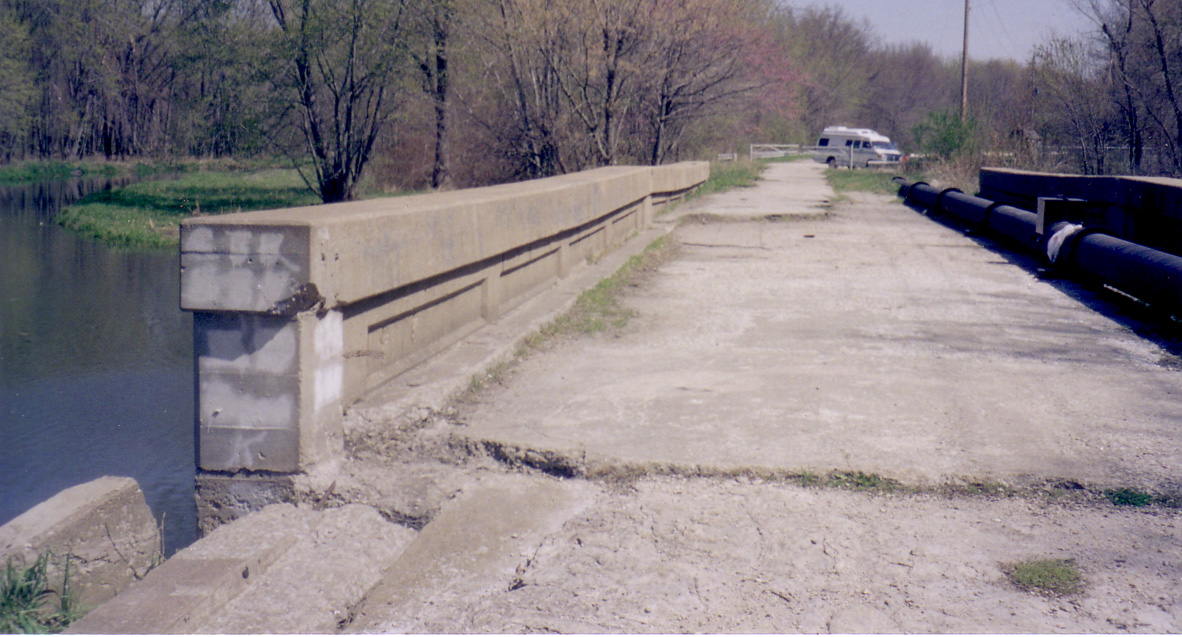
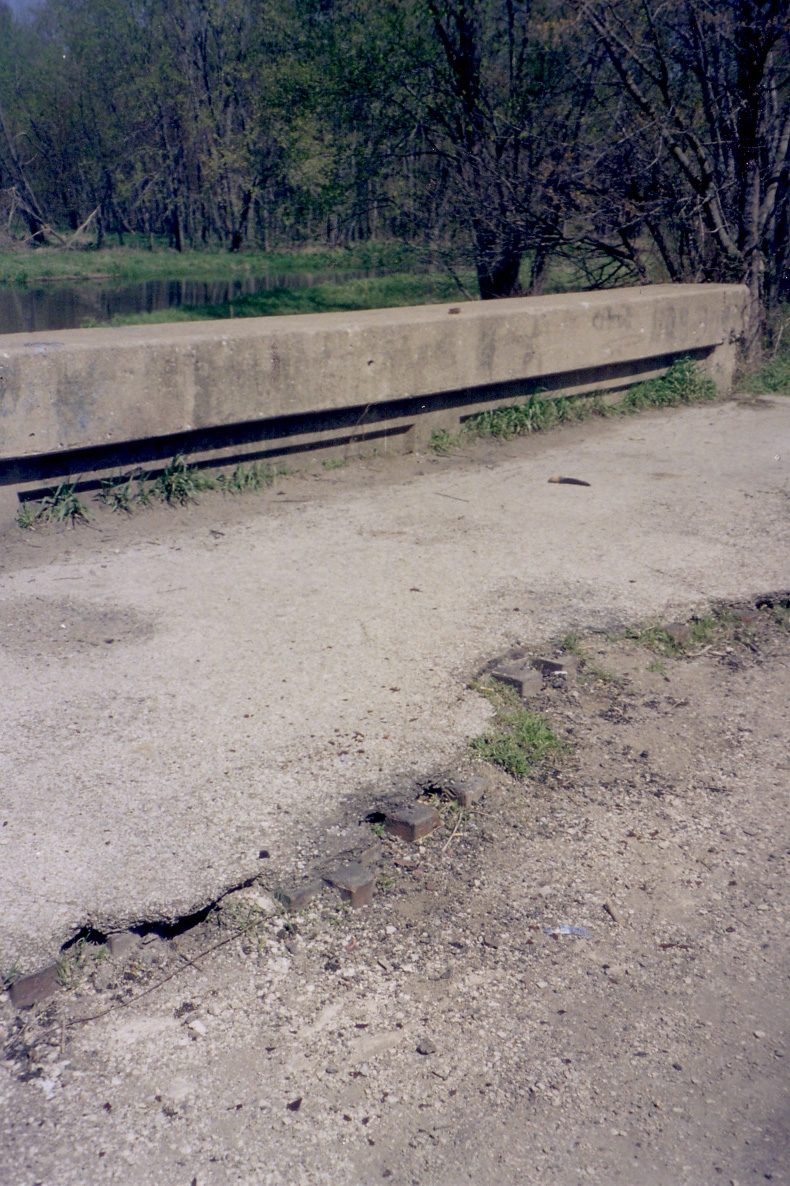
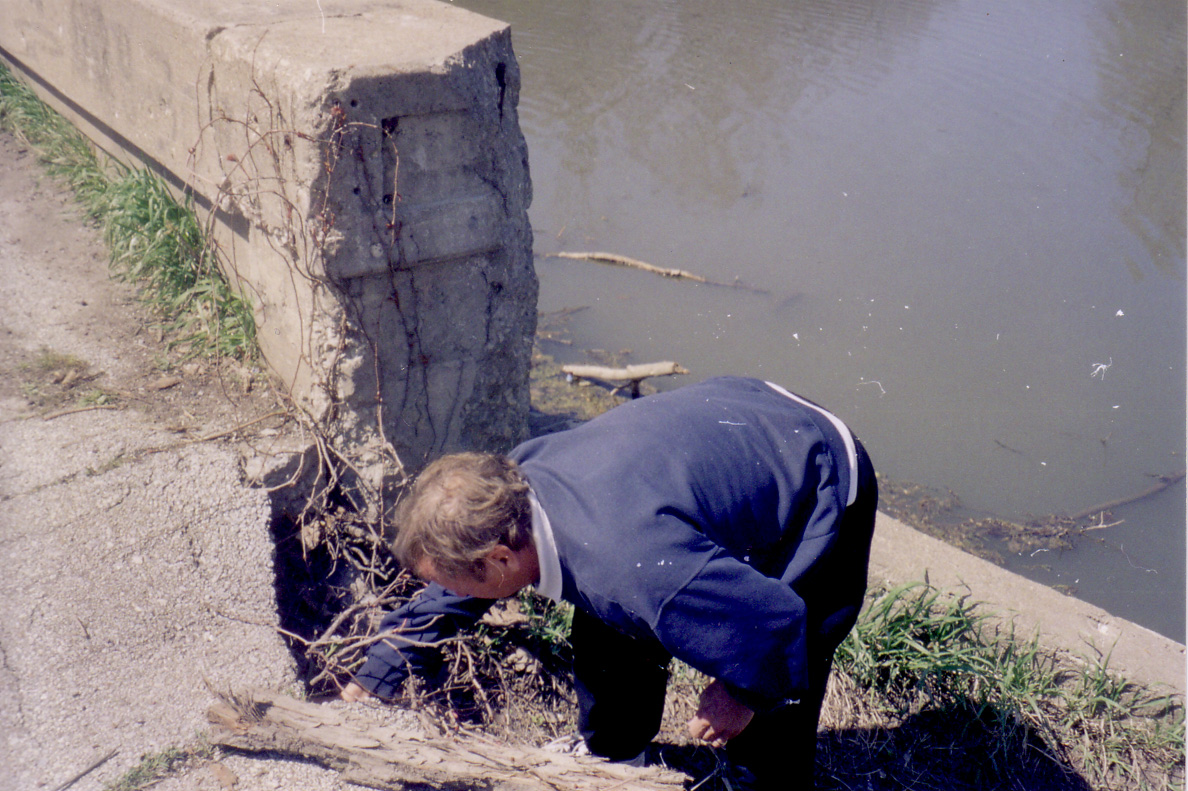
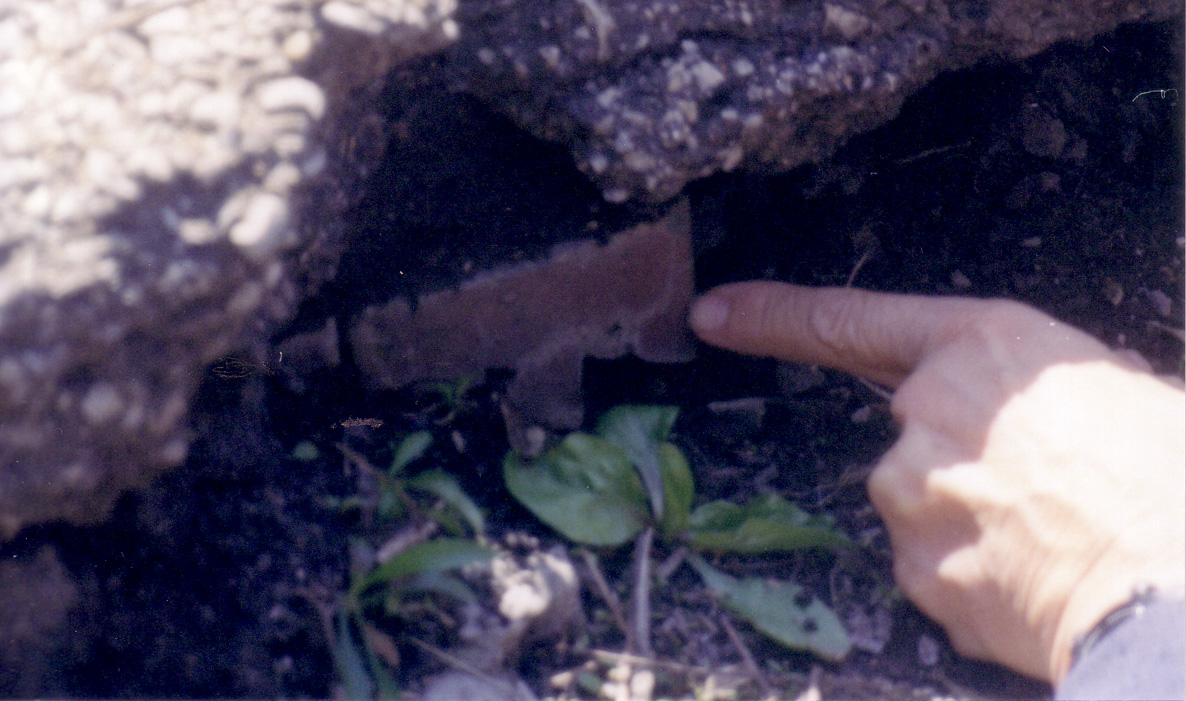
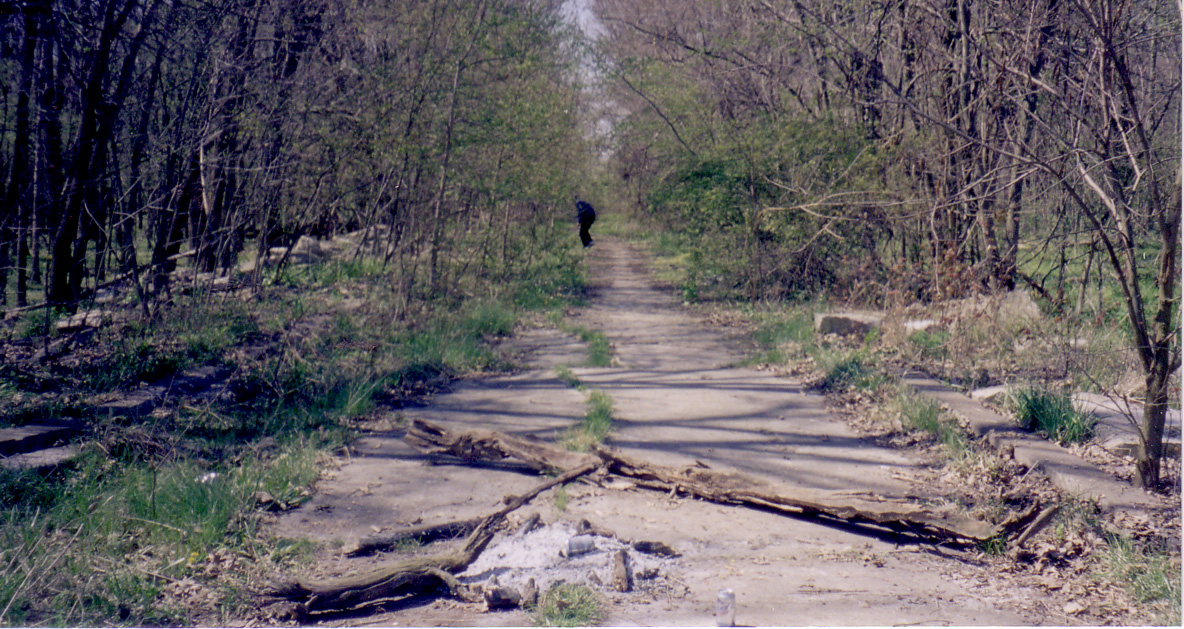
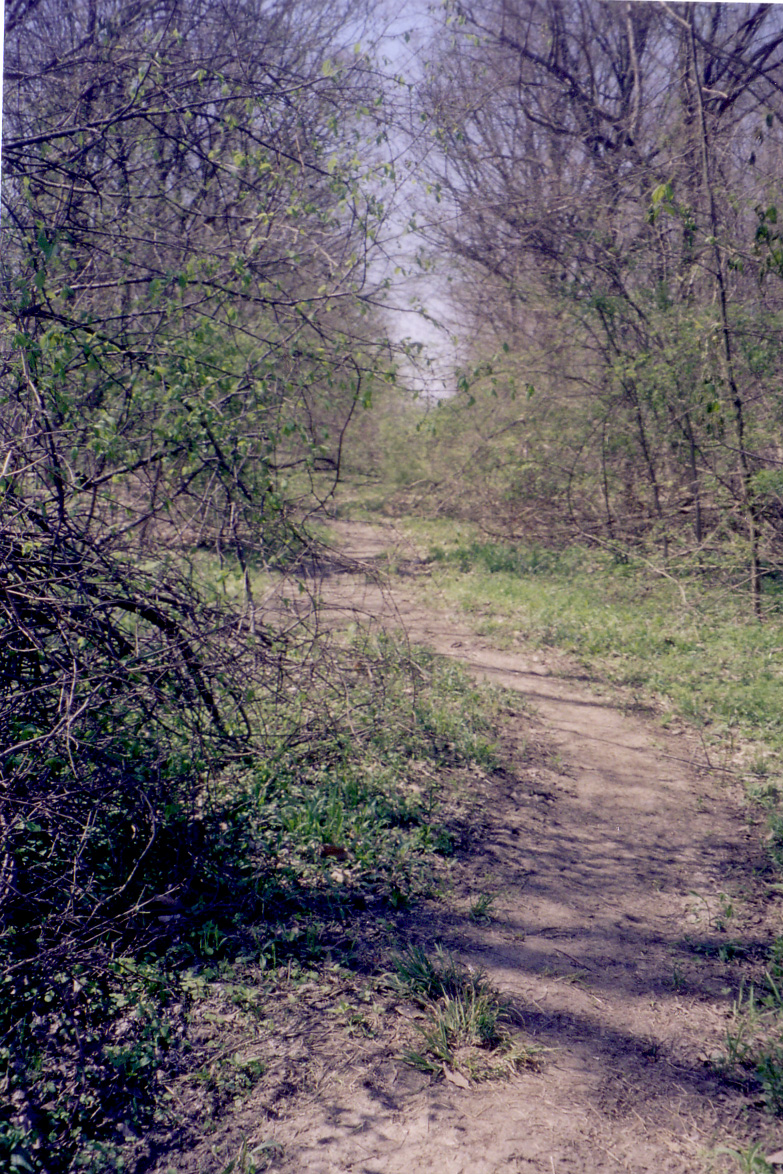
At the dead end section of "old Chatham Road, Illinois, near Auburn, encountered was a swampy area and the closed "Snake Bridge" over Lick Creek. Here in the base of the bridge observed were original bricks . Covering them was an old layer of asphalt.
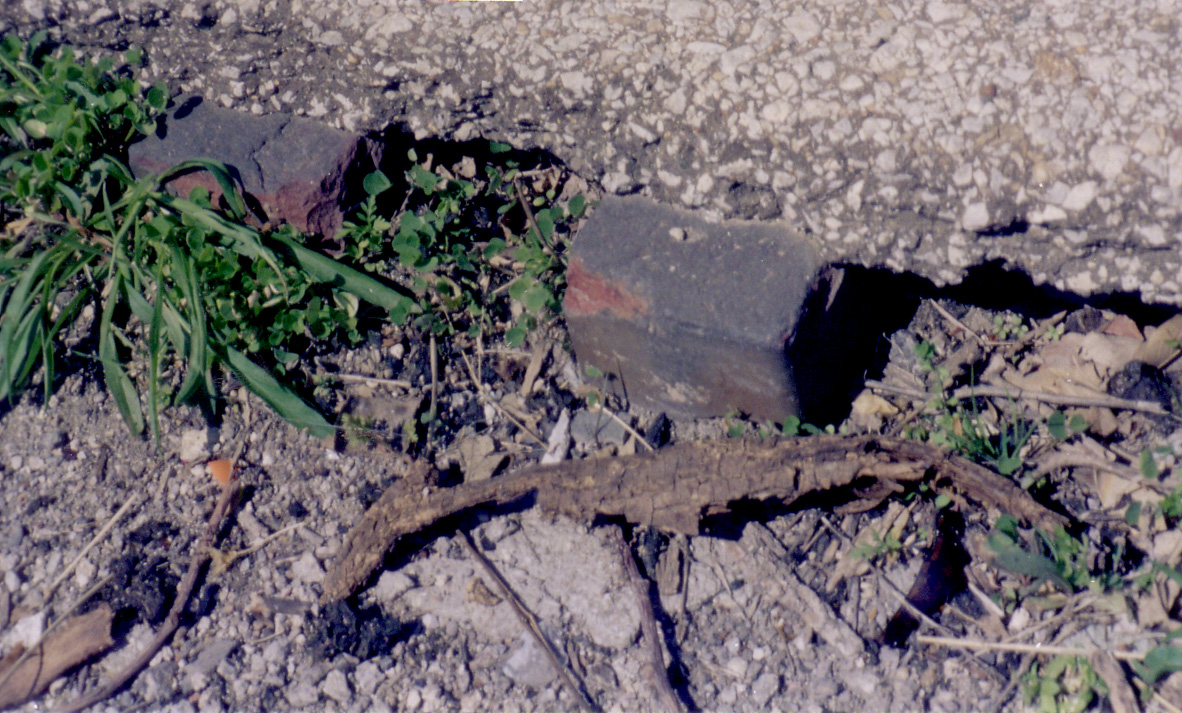
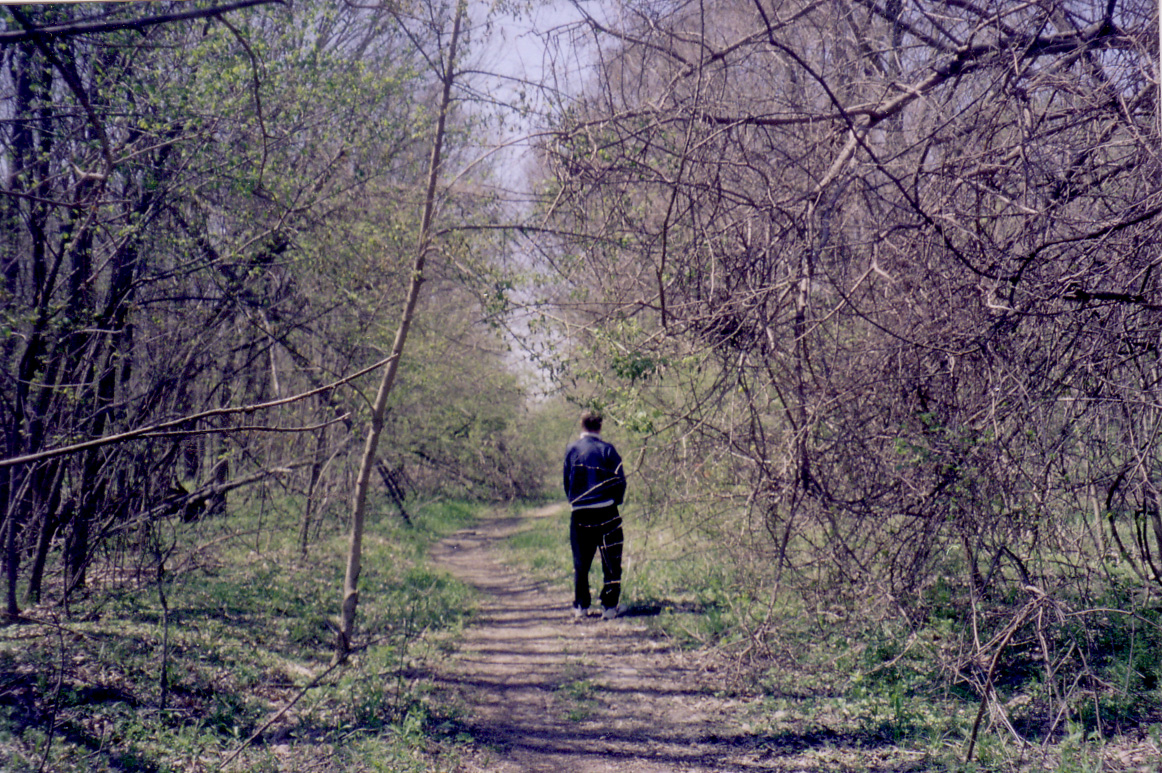
In the distance now disappearing into the bush was the original US 66. It was now grass and tree covered. Its original surface of bricks lay scattered here and there. Two bricks in particular stood out as they were complete.
Each of these bricks measured 8-1/2 x 4 x 2-1/2 inches. Each weighed [future]. They were hand made, without markings.
 |
 |
 |
||
| 1. | 2. | 3. | ||
 |
 |
 |
||
| 4. | 5. | 6. | ||
 |
 |
 |
||
| 7. | 8. | 9. |
Printed Sources
Blakenberger, Steven D, "The Paving Brick Industry in Ohio," Ohio Geology, No. 3 (A Quarterly Publication of the Ohio Department of Natural Resources, Division of Geological Survey 1999), pp. 1-5.
Butler, J. L., First Highways of America, (USA, F&W Publications Inc, 1994), pp. 108-112.
National Register of Historic Places, Illinois, Route 4, North of Auburn, County of Sangamon, Chatam Township, Curran and Snell Roads
Pauls, J T, “A resume is presented of the accelerated wear tests made by the U.S. Bureau of Public Roads in 1920-1921; The study of rolled base brick roads made in Ohio in 1921; A study in 1924 of brick roads in Florida laid upon sand subgrades; A study of behavior of brick surfaces under impact by the U.S. Bureau of Public roads in 1921 and the study of thin brick pavements by the Bureau in,” in Highway Research Board Proceedings, Vol. 7, Part I, (Highway Research Board, 1928), pp. 188-190.
Pierce, Vernon M. and Moorefield, Charles H., Office of Public Roads, Bulletin 373, "Brick Roads" (August 25, 1916).
Specifications for the construction of vitrified brick street pavements and vitrified brick highways, National Paving Brick Manufacturers Association (Cleveland, F.H. Kimball Co.,1914)
Swineford, F E and Schofield, H Z , "Brick Test Roads Under Traffic May Point The Way To Improved Construction Methods" in Highway Research Board Proceedings Vol. 18, Part 1, (Highway Research Board, 1938), pp. 175-180.
"When better roads are built, the Arizona highway department will build them", Arizona Highways, (December 1939:49).
INTERNET RESOURCES
http://www.azdot.gov/EEG_common/documents/files/cultural/good_roads/gdrds_chapter_1_2_and_3.pdf (A scholarly research paper: K:\11344\130\final\report 03-04.doc)
http://www.flaglercounty.org/brickrd/brick.htm (Links to scholarly research papers)
http://www.flaglercounty.org/brickrd/bricks.pdf (A scholarly research paper)