ERIC KRAUSE
In
business since 1996
- © Krause House
Info-Research Solutions -
_____________________________________________________________________________________
BACKGROUND GENEALOGY
MOLOTSCHNA COLONY - SUMMARIES
1803-1804
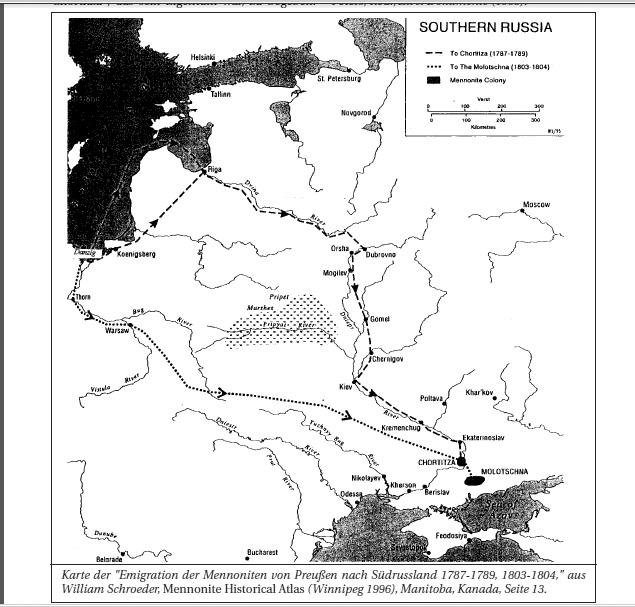
http://www.plettfoundation.org/Books/DieseSteine/1-68.pdf
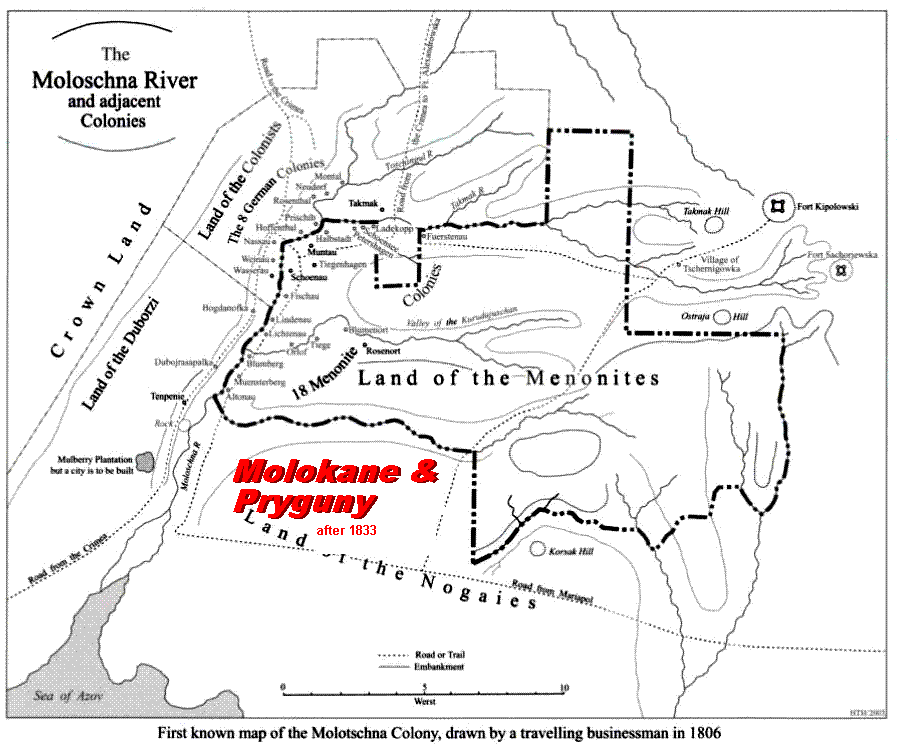
1806
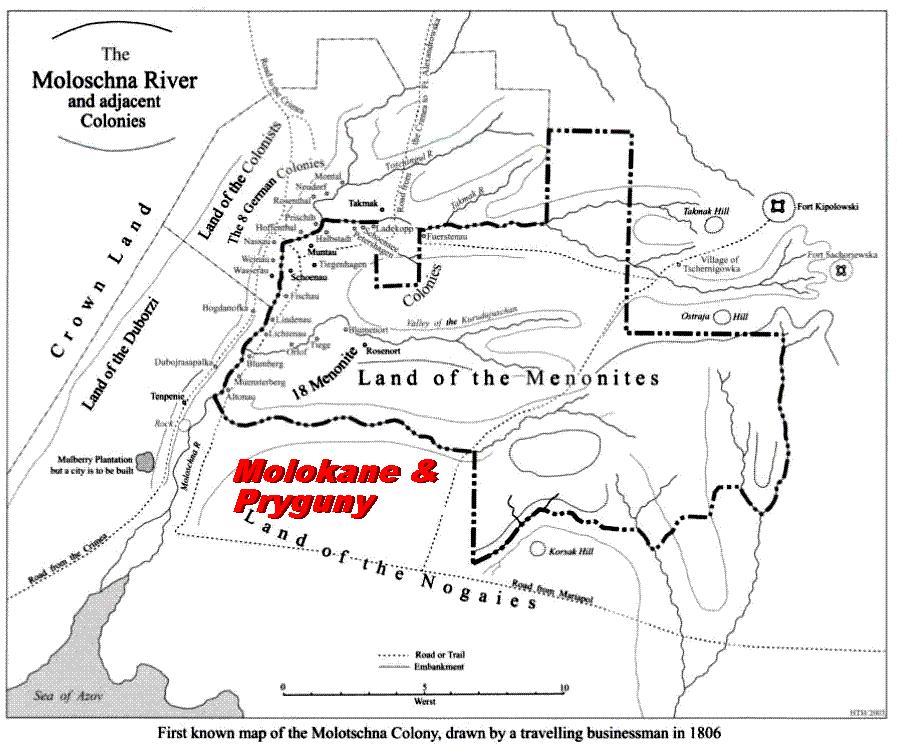
Russian Quakers - Molokany [Molokane] - A document sent to
William Allen in the year 1830, gave the following information:
"Between the German colonies of Mennonites and the Nogay Tartars, lies the
county of the Malakans,
a sect so named on account of their non-observance of fasts, and their use of
milk diet on week-days.
The Malakans also call themselves 'true spiritual Christians.'
http://www.molokane.org/places/FSU/Ukraine/Tavria_map_2.GIF
1850-1851
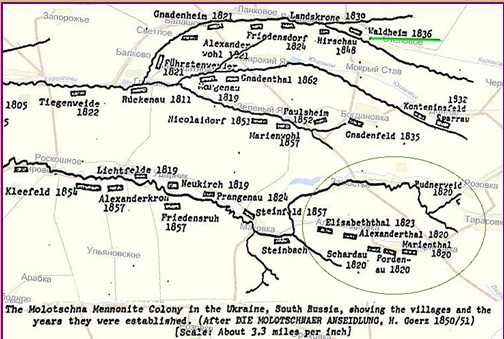
http://www.dakotadirksens.com/index_holland2shafter.php
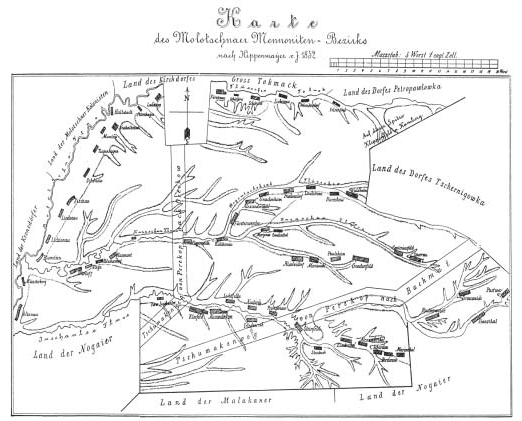
1852
http://www.plettfoundation.org/Books/DieseSteine/230-483.pdf
1865
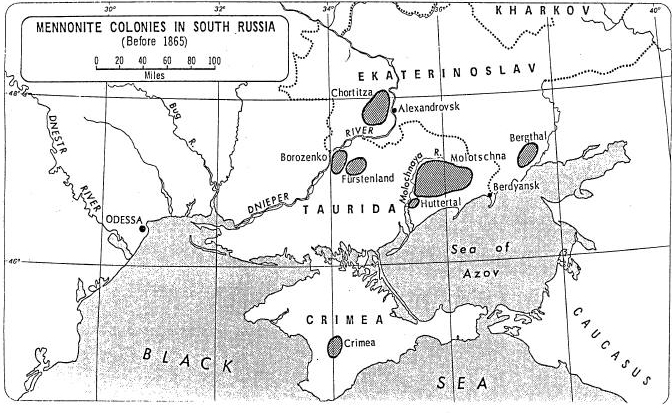
Josephine Chipman, The Mennonite Selbstschutz in the Ukraine: 1918-1919. MA Thesis (University of Manitoba, March, 1988).
NO DATE
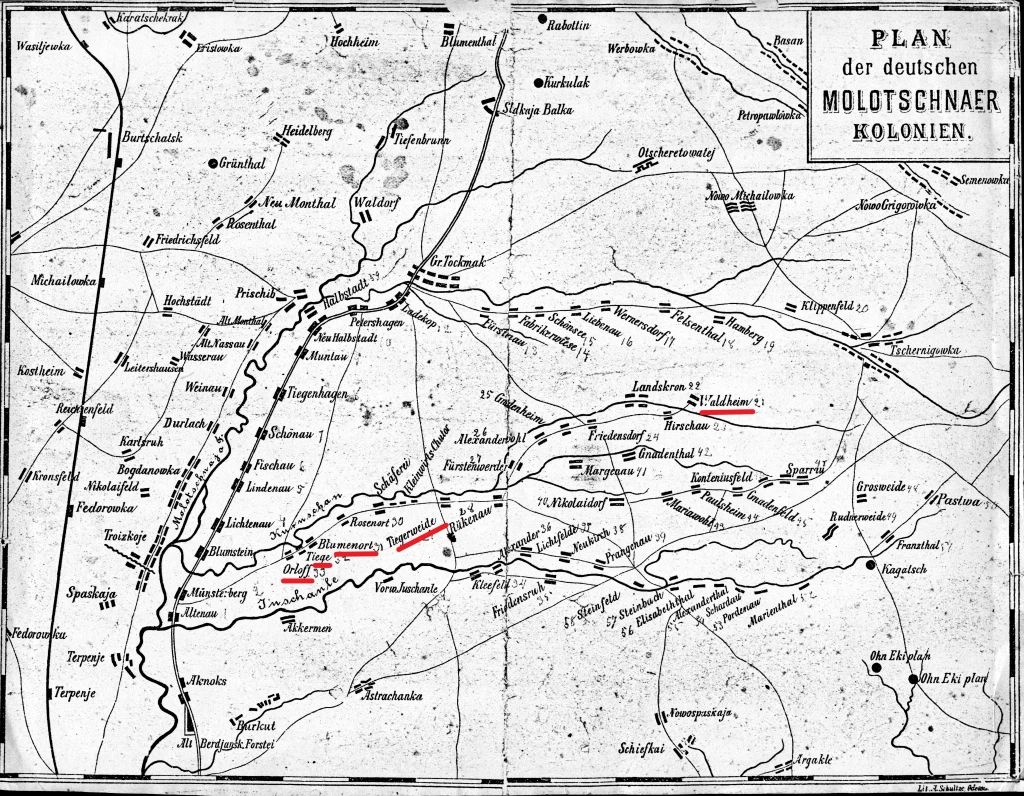
https://gerhardsjourney.files.wordpress.com/2018/03/molochna-map-really-good-red-lines2.jpg?w=1024
South Russia Mennonites
Ekaterinoslav (now Dnipropetrovsk since 1917), was a province (oblast in Russian) of the Ukraine, Russia, crossed by the Dnieper River, and was founded in 1786, and named after Catherine [The Great] II. Ekaterinoslav is bordered on the north by Poltava, on the east by Kharkov, on the south by Taurida, and on the west by Kherson.
In the year 1789 and then started again after 1803, the second large emigration of Mennonites from Danzig [present-day Gdańsk, Poland]-West Prussia began. It led through Riga into the Black Sea area to Chortitza (founded 1789) and Molotschna (founded 1804). The Schönfeld Colony was founded in 1868.
Molotschna Colony
The Molotschna Colony existed in what is now Zaporizhia Oblast (province) in the Ukraine and was named after the Molotschna River which forms its western boundary. It was founded by Mennonite settlers from West Prussia and consisted of 57 villages and was the second and largest settlement of Mennonites in Russia. Since the end of World War II, that area is now populated by Ukrainians and Russians.
Relevant villages: Halbstadt was founded in 1804; Tiegenhagen in 1805; Pordenau in 1820; and Alexanderkrone in 1857.
[Source:
Preservings - being the Journal of the Flemish Mennonite Historical Society (No.
24, December 2004)] Mennonite Villages in Molotschna, Ukraine
Alexanderkrone, Alexandertal, Alexanderwohl, Altona,
Blumenort, Blumstein, Elisabethtal, Fabrikerwiese, Felsental, Fischau,
Franztal, Friedensdorf, Friedensruh, Fuerstenau, Fuerstenwerder, Gnadenfeld,
Gnadenheim, Gnadental, Grossweide, Halbstadt, Hamberg, Hierschau, Kleefeld,
Klippenfeld, Konteniusfeld, Ladekopp, Landskrone, Lichtenau, Lichtfelde,
Liebenau, Lindenau, Margenau, Mariawohl, Marienhal, Muntau, Muensterberg,
Neu-Halbstadt, Neukirch, Niklaidorf, Ohrloff, Pastwa, Paulsheim, Petershagen,
Pordenau, Prangenau, Rosenort, Rueckenau, Rudnerweide, Schardau, Schoenau,
Schoensee, Sparrau, Steinbach, Steinfeld, Tiege, Tiegenhagen, Tiegerweide,
Waldheim, Wernersdorf, Yushanlee 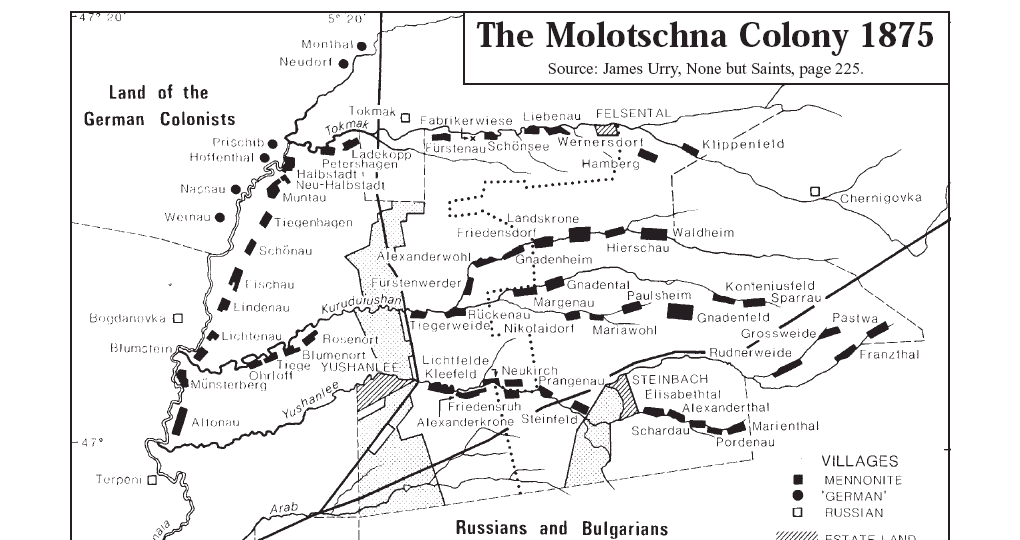
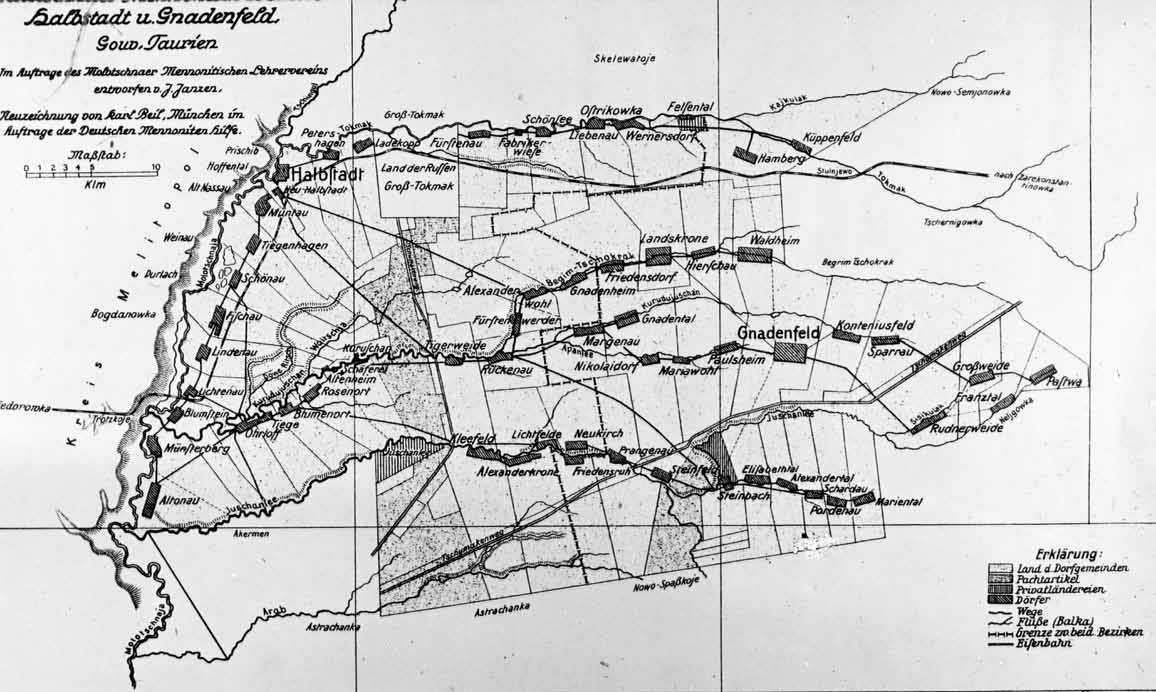
Overview
The Government of Taurida (also spelled Tavrida and Taurien), was an administrative district in the Russian Empire. It included the mainland between the lower Dnieper River and the coasts of the Black Sea and the Sea of Azov (63,538 km) and the Crimean peninsula (26,000 km). The center of the administrative district was the city of Simferopol.
Taurida was dissolved during the Russian Revolution in 1917-1918, when oblasts replaced the gubernias. Its territory was divided between Ukraine in the north, and Crimea in the south. In 1921, Crimea was formed into the Crimean Autonomous S.S.R. Crimea then passed to Soviet Russia (one republic within the Soviet Union) and in 1954 was tranferred to Ukraine. Formerly an oblast (province), it became a republic in the early 1990s.
Ethnic Germans began settling in Crimea on the mainland of Taurida in spring 1789 when a group of Mennonites from West Prussia arrived and settled an area just south of Jekatarinoslaw on the banks of the Chortitza River. Within a few years, there were 18 villages in this enclave, which eventually increased to a total of 37 Mennonite villages.
Another significant area of German-Russian settlement within Taurida was the Molotschna enclave of colonies, north of present-day Melitopol, Ukraine. Karl Stumpp lists 24 original colonies of the Molotschna or Prischib district, not including the numerous Mennonite settlements on the east side of the Molotschna River. Some historians refer to the Lutheran colonies on the west side of the Molotschna River, established as early as 1805, as the Prischib district.
Scattered among the Lutheran colonies on the west side of the river were also several Catholic colonies, which were established after 1809. The exception is the Catholic colony of Blumental on the east side of the Molotschna River, which was established in 1822. But it was the Mennonites who dominated the Molotschna district, forming an enclave that would eventually include 55 villages. In later years, the landless sons of these and the Chortitza villages began buying land all over Taurida and formed another 30 villages for a total of 122 Mennonite villages in Taurida.
An enclave of Lutheran villages formed north of Mariupol and eventually included about 25 Lutheran villages, about 10 Catholic villages, and a scattering of Mennonite villages. The village of Grunau was the Lutheran parish head for this enclave.
The Belowesch colonies new Cherigov, founded by 147 families from Hessen and Oldenwald in 1766, sent 36 families to form a daughter colony near the Grunau Lutheran villages in 1802. In 1831, the original Belowesch colonies accepted a government offer of land in the Mariupol region, which absorbed 122 families who founded five more colonies south of Grunau in 1832.
In 1822, a group of Swabian Separatist colonists arrived in Taurida and formed three Separatist colonies - Neuhoffnung, Neuhoffnungstal, and Rosenfeld - near the Russian town of Berdjansk. Neu Stuttgart was formed in the same area in 1824. By 1914, all of the villages had become mostly Lutheran colonies with the exception of Neuhoffnung which remained Separatist until the end.
In 1835, a group of 69 Hutterite families formed the villages of Johannesruh and Huttertal near Melitopol in southern Taurida. Soon several other Lutheran villages sprang up around this same area.
Although the predominant religions of the Taurida German-Russians were Mennonite and Lutheran, by 1941 there were also approximately 35 Catholic villages scattered throughout the mainland. Ethnic Germans began settling in Crimea in 1804, coming from Württemberg, Baden, and the Palatinate as well as Switzerland and Alsace. Starting in about 1860, many landless sons of colonists from all areas of the Black Sea region began migrating to the open land in Crimea. This migration reached its peak in the 1880s, but continued until about 1914.
While colonists were streaming into Crimea from the north, many colonists had already begun to emigrate from Crimea to North America and Canada. In 1941, all ethnic Germans were forced to leave Crimea and were resettled in Siberia and central Asia.
In all, the mainland of Taurida contained over 325 German villages and chutors. The peninsula of Crimea contained over 540 villages and chutors.
http://www.blackseagr.org/learn_crimea.html
1897
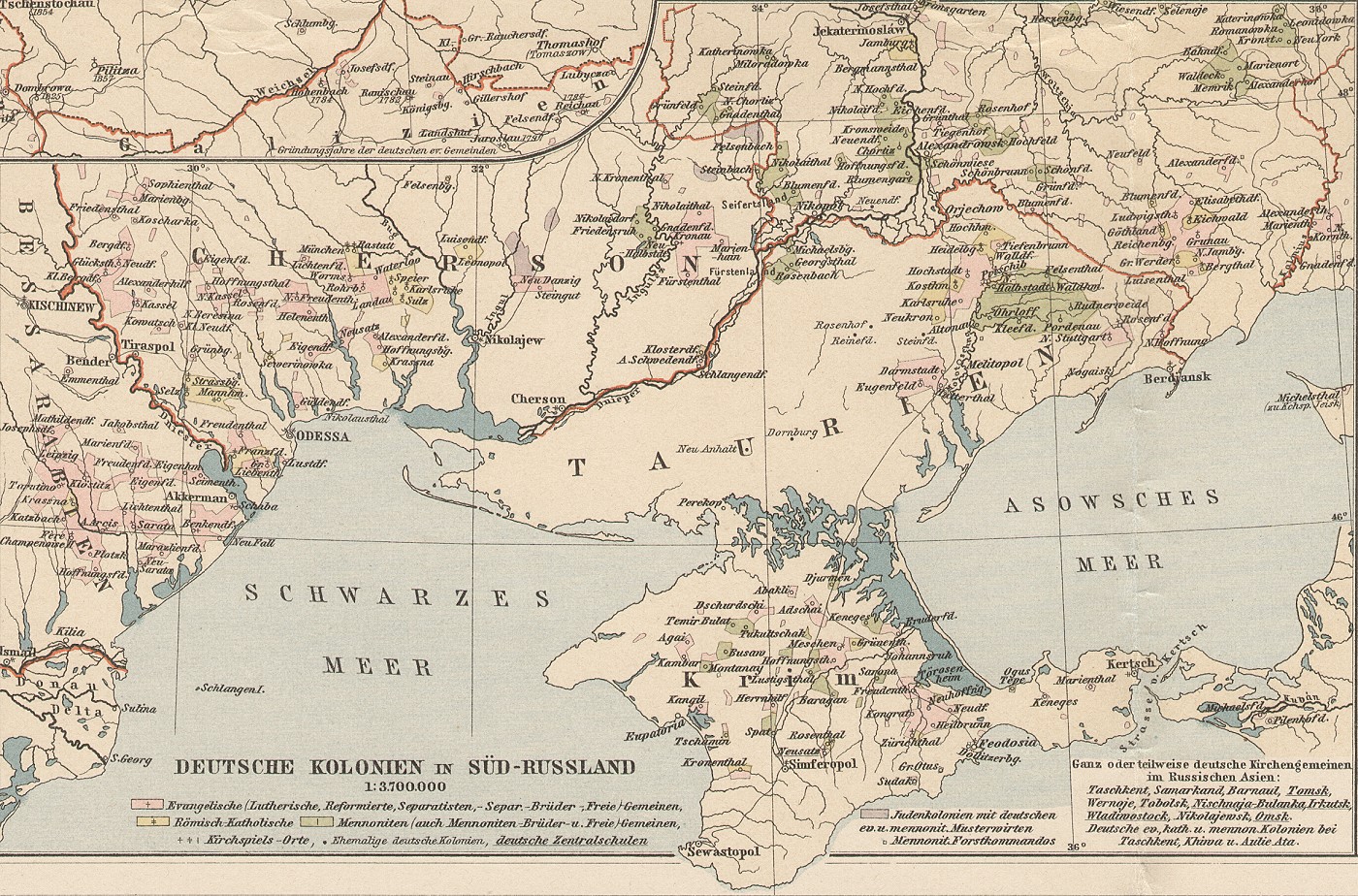
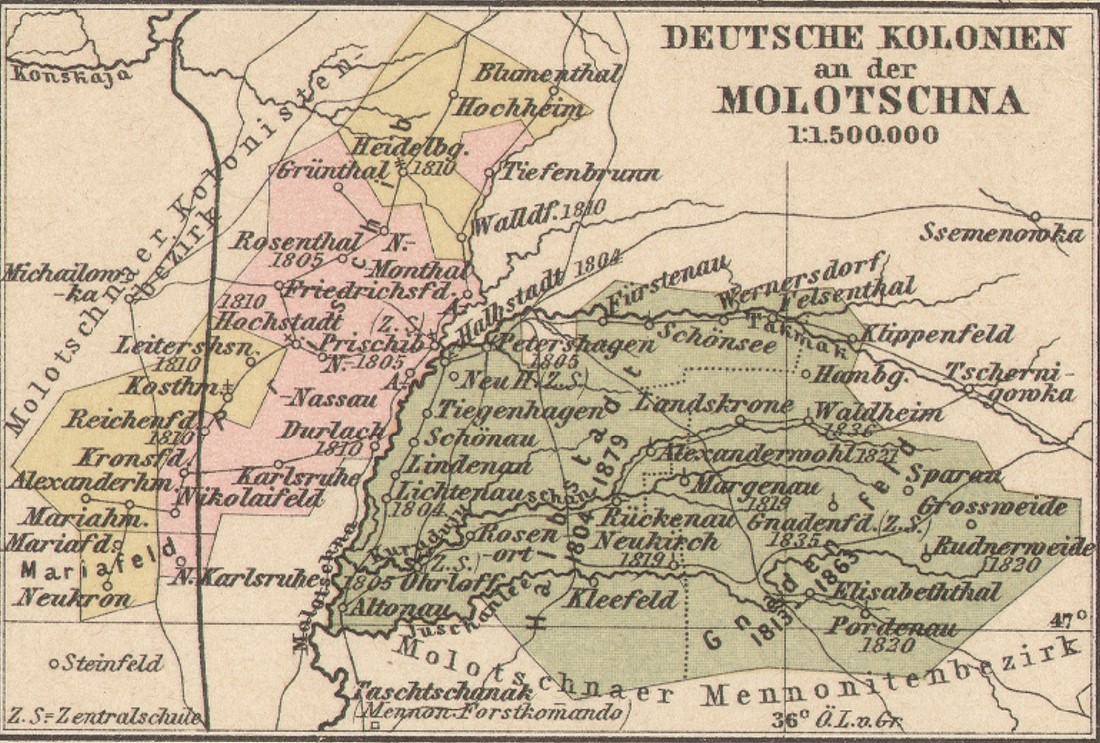
Langhans, Paul - Deutsche Kolonisation im Osten II. Auf slavischem Boden. Aus Langhans Deutscher Kolonial-Atlas, Karte Nr. 7. Gotha, Justus Perthes, abgeschlossen Juli 1897.
http://www.elke-rehder.de/Antiquariat/dekorative-Grafik-Varia/Deutsche-Kolonien-Slawien.htm
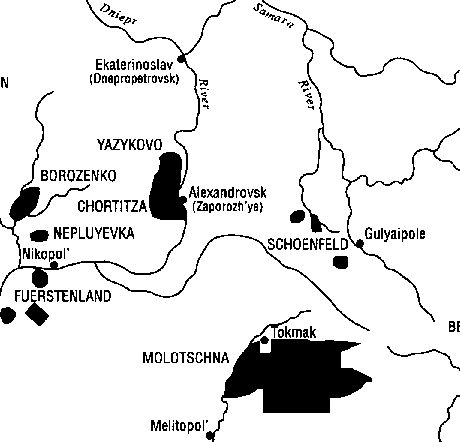
http://fistfulofeuros.net/pedantry/archives/000176.html
The voyage to the new land was not an unproblematic journey. During the trip, luggage was stolen, the Russian government failed to meet many of the promised financial agreements, and there was a failure in the leadership and unity within the group of Mennonites. Frederick William III, the leader of Prussia, was against the emigration of the Mennonites, so he set a restriction that the Mennonites had to pay exit taxes of 10% of their possessions. To encourage the Mennonites to continue with their decision to emigrate, the Tsar Paul I of Russia offered more privileges to counteract the restrictions. Interest-free loans and 120,000 more dessiatines of land east of the Molochnaya River were given. In 1803, 1,020 Mennonites left Prussia in horse-drawn, covered wagons. Their farms were sold at reasonable prices and they started a voyage of five to seven weeks. After this group wintered at the Chortitza Colony, they set out for the east bank of the Molochnaya River. After 1828, Russia discontinued their financial help and only those who had enough money were able to leave Prussia and inhabit the steppes of Russia. In the Molotschna Colony alone, there were more than 1,000 Mennonite immigrants. [Source: http://freepages.family.rootsweb.com/~elmcreekschool/Shawna/LivingHistory%20writeup-Shawna.doc. ]
In 1905 the Molotschna settlement had the following congregations (the figures in parentheses indicate the year of founding and the total membership including children): Halbstadt (1895; 1174), Lichtenau (1823; 3338), Petershagen (?; 722), Schönfeld and branches (1868 ft; 763), Blumenfeld (1872; 135), Rosenhof (1870; 419), Ohrloff (1804; 980), Herzenberg (1881; 80), Alexanderkrone (1890; 1305), Neukirch (1863; 890), Alexanderwohl (1820; 680), Schönsee (1830; 1425), Gnadenfeld (and branches) (1834 ff.; 1151), Pordenau (1842; 1771), Rudnerweide (1820; 2548), Margenau (1832; 2876), Waldheim (1836; 219). The Mennonite Brethren were organized as the Rückenau Mennonite Brethren Church, with a number of branches (1860; 1977). In 1926 the total membership (including children) of the combined Mennonite congregations in the Molotschna was 15,036, of the Mennonite Brethren 2,501, and the Evangelical Mennonite Brethren 810, a total of 17,347. Another source says there were 20,706 Mennonites in the Molotschna settlement in 1922. Taking into consideration the natural increase it may be concluded that some 4,000 must have emigrated to America in 1922-1926.
After World War I
World War I had the same effect on the Molotschna settlement as on the other settlements in Russia. The suffering inflicted by the Bolshevik Revolution, the bandits of Makhno, the civil war, drought, and starvation was gradually overcome, partly through American Mennonite relief. According to a report entitled "American Mennonite Relief Scheme" there was a population of 20,706 in the Molotschna in 1922, of whom 11,134 received relief food. The Association of Citizens of Dutch Origin (Verband Burger hollandischer Herkunft) did much to prevent great disaster, and to help to restore the economic, cultural, and religious life. The NEP period made this restoration possible. Soon, however, the great Mennonite emigration to Canada set in (1921), which was discontinued by 1927. Again in 1929 a small number succeeded in leaving Russia for Canada. How many of the 25,000 emigrants from Russia who went to North America after World War I came from the Molotschna has never been established ...
[SOURCE: http://www.gameo.org/encyclopedia/contents/M6521.html ]
Black Sea Germans settled along the north coast of the Black Sea starting in 1804 especially in Kherson, Tavrida, and Yekaterinoslav provinces in Ukraine and including colonies around Alt Danzig, Beresan, Bessarabia, Crimea, Dobrudja, Khortitsa, Molotscna, and Odessa. They were a mix of Evangelical Lutherans, Catholics, and Mennonites. In 1897 there were 345,000 settlers. Some migrated from these settlement to secondary settlements in the Caucasus region. The biggest concentration of Black Sea German emigrants to the United States is in North and South Dakota. ...
[Source: https://wiki.familysearch.org/en/Germans_from_Russia_Historical_Geography ]
Molochna Chronology (1917 - 1920)
Under Provisional Government: March 1917 – January 1918
1st Bolshevik Occupation: January 1918 – 18 April 1918
2nd Bolshevik [Makhno] Occupation: 11 March 1919 – 26 June 1919
Under White Army [Denikin] Occupation: 26 June 1919 – 8 October 1919
Makhnovtsy Occupy Molochna: 8 October – 16 November 1919
3rd Bolshevik Occupation: January 1920 – 5 July 1920
Under White Army [Wrangel] Occupation: 5 July 1920 – October 1920
4th Bolshevik Occupation: October 1920 . . .
1917 -
Mennozentrum (Bureau der Molotschnaer Mennonitischen Vereinigung)
Mennozentrum was the executive body and office of the Bureau der Molotschnaer Mennonitischen Vereinigung in South Russia organized during the Revolution in 1917. At the meeting of the Allgemeiner Mennonitischer Kongress at Ohrloff in August 1917 the following members were elected to the Mennozentrum, or Zentralbureau, with the highest votes: B. H. Unruh (202), Dr. Peter Dück (192), Heinrich Schröder (182), Heinrich Janz (176), Heinrich Epp (177). This executive body played a significant role in negotiating with the temporary governments such as those of Kerensky and Denikin, the German government, and other organizations including the Verband russischer Burger deutscher Zunge. The first chairman of this executive body was Johann Willms, who was succeeded by B. H. Unruh. At a regional Molotschna meeting of the Kongress at Rückenau, a Studien-kommission was appointed to investigate settlement possibilities abroad for the Mennonites of Russia. Those elected were A. A. Friesen, B. H. Unruh, Heinrich Warkentin, and Daniel Enns. The latter declined to serve as did also his alternate Jakob Neufeld. Johann Esau joined the Studien-kommission temporarily. Not much is known about the activities of the Mennozentrum after this
In 1923, it was the Russlaender of Chortiza who emigrated. In 1924 came the turn of the Molochna colony ... The last year of large-scale movement was 1926, involving nearly 6,000 emmigrants ... [ Arthur Kroeger , Passage: A Mennonite Family's Long Journey from Russia to Canada (University of Alberta, 2007) , pp. 93, 95] http://books.google.com/books?id=0npCo1Oj6ewC&printsec=frontcover&dq=hard+passage&sig=ACfU3U25QGFji62A_eYekjhL5jdDRxvHmg
Those who could not pass the medical exam—usually because of trachoma—were allowed to stay in Germany and Southampton, England until they were healthy. [http://www.nationmaster.com/encyclopedia/Russian-Mennonite ]
1932
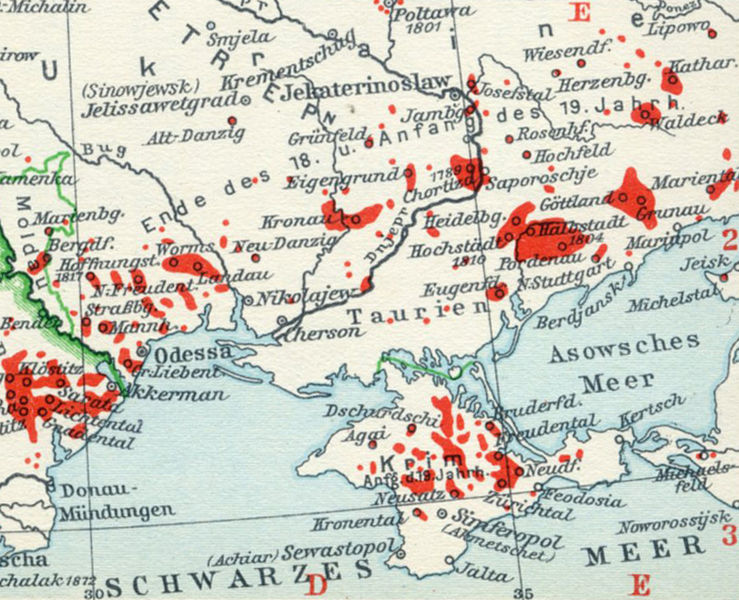
Edgar Lehmann, Meyers Handatlas, ausgabe B, Bibliographisches Inst., Leipzig 1932
http://de.wikipedia.org/wiki/Schwarzmeerdeutsche
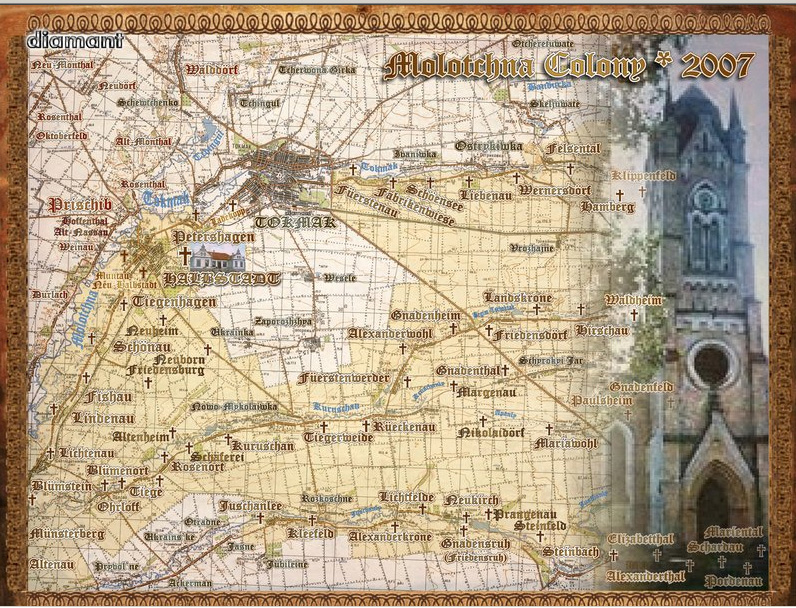
http://travel-to-ukraine.net/content/halbstadt