Corresponding
to the
important
strategic
goal,
followed by
the big
batlle
planed, it
was put to
Mackensen
disposal an
impozant
military
force. The
Mackensen
army groups
was made,
from west to
east, of
three
armies: IXth
Army, Rimnic
Group and
Danube
(river)
Group. The
army which
was to start
the
offensive
was the IXth
german.
Until May,
it was
commanded by
Falkehayn;
he was then
send to Asia
Minor to
organize the
Turkish-german
armies “Yildirim”(spelling
ilthrm?).
his
successor
was General
von Eben,
ex-commander
on the
galitian
front.
The front of
the german
IXth army
started,
considered
from east to
west, at
Suraia on
Siret river,
10 km lower
than the
place where
Putna flows
into
Siret.This
front was
following
the Siret
till
Biliesti, in
front of Movileni de
Jos (lower
Movileni),
then it was
farring
Siret, taken
the
north-east
direction,
going
through Siret field,
meeting at
Paraipan
(Balta Ratei=duck
pond) the
Putna
valley,
following
then all the
time the
southern
shore of
this valley,
cutting the
road
Focsani-Marasesti
at the 10th
kilometer,
north of
Faureni,
then cutting
the railway
south of
railway
station
Putna Seaca,
all the way
to Iresti.
here in the
point where
putna valley
makes an
angle,
towards
south –west
to enter
Vrancea, the
IXth Army
was
connecting
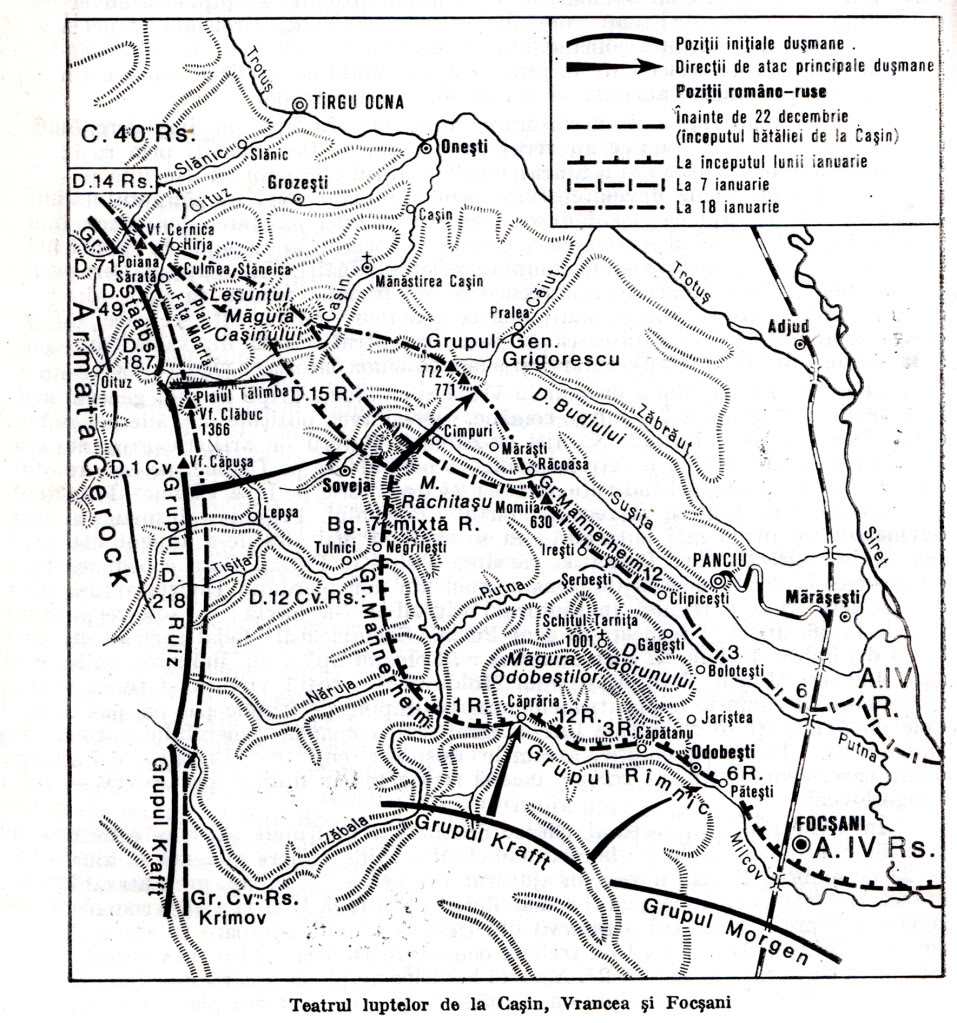
with Gerock
Army.
the german
front was
itself
cutting
itself
towards
south-west,
to draw the
curve line,
to which it
has been
pushed by
our(romanian)
victory at
Marasti. On
this opening
of 60km the
german front
was split
into two
sectors:
a) Sector I
reserve
Corps,
stretching
from Suraia
to a line
wich would
cut Putna
valley and
Susita, with
south-north
direction,
between
Ivancesti
village and
Satu Nou
village. The
terrain is
flat with
gorges, some
of them with
water some
of them dry,
with the
west –east
direction
and and cut
across by
the road and
railway
Focsani
–Marasesti,
of which
direction is
north-south.
General von
Morgen,
the
commander of
the Ist
reserve
Corps, had
in this
sector,
without
counting the
divisions,
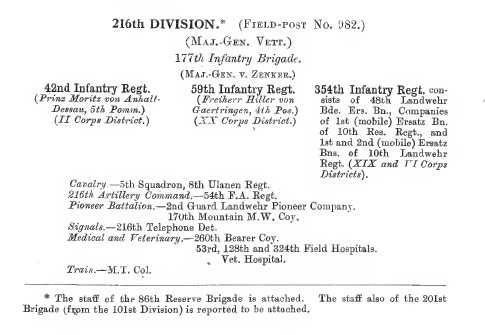
89 prusian,
12 bavarian
and
216 saxon,
which were
making the
Ist Corps,
of two more
divisions:
reserve 76
and 115. To
have the
troops
concentrated
in the
attack zone
itself,
Divission
12th
Bavarian,
which
previously
occupied the
shore of
Siret,
between
Biliesti and
Suraia, was
withdraw and
taken south
of Padurea
Neagra
(black
forrest),
between
Paraipan and
Biliesti. In
the place of
this
division was
created a
new one,
Divission
303 commnded
by General
Wehmer-made
out of seven
infantry
battalions
de Landsturm,
taken from
the
occupation
force of
Muntenia.
this
subsector
will have a
pure
defensive
and
observation
role.
b) the
sector of
the XVIII
army Corps,
spread from
line
Ivancesti-Satu
Nou, till
Iresti. It
is a terrain
of hills
covered with
orchards of
wine grapes
towards east
and with
forrests
toward west
which,
starting
from the
valleys of
Putna and
Susita are
rising in
higher and
higher
mountain
ridges
toward west.
At south,
Magura
Odobestilor
dominates
with its
crenelated
cannopy the
whole
region.
XVIIIth
Corps was
constituted
by 62nd
austro-hungarian
Division, of
217th german
Division and
by
detachments
Stange and
Vogel, of
the value of
a division,
made out of
troops taken
from
divisions
101st and
69th:
regiments
29th, 59th,
3rd
grenadieri
and of three
german
infantry
battalions.
Together
with 217th
divission
these
detachments
made
Gallwitz
Group. The
command of
XVIII was
given to
bavarian
General von
Wenninger,
brought in
the eve of
the battle
from the
french
front.
As a reserve
for the IXth
army there
were: german
Division 12
at
Focsani,
13th
Austrian
Division a
liitle south
of Plainesti,
and from the
French front
arrived
bavarian
Alpine
Corps. The
units and
the weaponry
- especialy
the
artillery -
have been
completed
with
elements
brought from
the
neighbouring
unuts from
the quiet
sectors and
from the
deposits
situated in
Muntenia
(central +south+east
part of
Romania,
also called
Wallachia).
with this
face, von
Eben Army,
destined to
force the
crossing
over Adjud,
was made of
12 fighting
divisions.
Numericaly,
was
constituted
of 102
infantry
battalions,
24 pioneers
companies
and 10
cavalry
escadrons.
The weapons
were very
strong: 1135
machineguns
and an
artillery
made out of
865 fire
mouths of
different
calibers.
The IXth
Army was
prolonging,
in the
eastern
direction
with the
other units
of the
general
Mackensen
Army Group.
- von Bahr
-The Danube
Army-Kosch -
constituted
of german
units,
austro-hungarian
units,
Bulgarians
and Turkish
units, which
occupied the
souther
shore of
Siret River,
till the
flowing
point of
this into
Danube
River,
between
Galati and
Braila; from
this point
it was the
Bulgarian
Army of
Dobrogea
–General
Nerezov.
The role of
the armies
on the lower
Siret was, that after
the run
through of
the enemy
front
(romanian-russian)
has been
made andd
the Ist
reserve
Corps would
have hit in
Tecuci
direction,
if the enemy
front will
surrender in
the face of
the german
front, they
will cross
Siret and
pursue;t he
right wing
to climb
Prut river
and cover
Galati
towards
East.
As the
germans were
finishing
their attack
preparatives,
the northern
shore of
Putna River
was
occupied, in
front of the
sector of
the IXth
german Army, of
units from
IVth Russian
Army-comanded
by Prince
General
Ragoza. The
Russian IV
th army was
mede
organicly of
three army
corpses:
VII,VIII and
XXX, of
three
division
each. Of
those only
three
divisions
were keeping
the front
line in the
face if the
IXth german
Army
and namely:
34th
Divission,
from
Movilenii de
Jos,and at
the right
wing, 103
Division,
from Sirbi
to Iresti.
Another two
divisions,
14th and
15th of the
VIII th
Corps- were
outside the
front of the
IXth german
army
having in
front Gerock
Group, from
Irest to
Sarii Valley
,in the
positions
earnetd by
the victory
of Marasti.
In reserve
they
had:71th
Division in
Zabrautu
valleyand
cavalry
Division
Zamurskaia
on the left
of Siret
river at
Nicoresti.
Other units
of the IVth
army have
been
retreated
previously
from the
fighting
zone ...
In the Eve
of the
Battle ...
In
the evening
of 5th of
August,
Mackensen
left
Bucharest
(which was
occupied by
the germans
at the
time), to, personaly
take charge
of the
battle which
will give
him Moldavia
and
Basarabia.
Shaking
hands of the
high
officers and
the germane-romanian
demnitaries
gathered on
the walk of
Bucharest-North-Railway
Station, to
wish him
luck, the
marshall
said good
bye with the
words: Good
Bye to weeks
from now in
Iasi
(biggest
city and
capital of
Moldavia and
also capital
of Romania
since
Bucharest
,the capital
was occupied
by Mackensen)).
And for two
weeks the
coffee shops
of Bucharest
sounded with
the words of
the marshal
Mackensen,and
the pro
german
Romanians
saluted with
joy “the
re-whole of
Romania”
through the
chains of
german
occupation
...
The
Breakthrough
of the
Russian
Front.
In
the night of
5-6 August
the german
artillery
started a
strong
bombardment
over the
line Faurei-Siret
and over the
eastern
shore of
Siret
river, south
of Movileni.
Shells of
different
calibers,
grenades,
shrapnel,
machinguning,
they were
all falling
like the
rain over
the Russian
lines
between the
railway and
Siret river,
and also
over the
Romanian
positions
across the
river.
Towards
morning,
waves of
axfixiant
gass emerged
from the
enemy lines
especially
over Padurea
Neagra(
Black
Forrest),
chocking the
air into a
dense fog.
Between the
clocks 4 and
7 in the
morning the
bombardment
reached an
extreme of
violence.
General von
Morgen had
the order to
execute with
the Ist
german Corps
the
breakthrough
of the
Russian
front. He
had thus
aligned on
the first
line of the
front three
divisions:
12th
Division on
the right
side leaned
over Siret
river, 89th
Division on
the left ,at
Faureni;
76th
Division in
the middle,
between the
other two.
Behind 12th
Division he
sat
216th
Division,
and in the
reserve he
kept the
115th
Division.
Like a
restrained
resort,
which
unstrains
instantly,
he then
started the
attack at
7:30 in the
morning, the
infantery of
the three
german
divisions
against the
russian
lines. It
wasn’t even
needed so
much power.
The Russians
are leaving,
one by one
their strong
positions.
Till midday
they lose
three lines
of defence,
which was
one in front
of the
other. The
germans
cross Putna
river on the
northern
shore ,then
they cross
Sovarga
valley and
finally
Putna-Seaca
valley. The
12th german
Division
occupied the
village
Radulesti,
Padurea-Neagra,and
then Ciuslea
village.
Some part of
the Russian
infantry
crosses the
boat bridge
thrown over
Siret river
at Ciuslea
village,and
they refuge
on the
eastern
shore of
Siret river.
At the order
of the
Russian
commander
they proceed
at burning
the bridge
.Following
the
Russians,
the germans
turn to the
right and
try to cross
the bridge
by surprise:
they stand
now in front
of the
burning
bridge and
they are
received by
a rain of
projectiles
thrown by
the Romanian
artillery
from the
front shore
of the
river.
Forced to
retreat, the
germans give
up the
crossing of
the bridge
over Siret
river and
organize,
for the
night to
come, to
force the
crossing
over: the
bridge parts
are brought
behind enemy
lines and
sheltered in
Padurea
Neagra (The
Black
Forrest).
At
the left
wing of the Ist german
Corps, the
76th
Division and
the left
wing of the
89th
Division
conquered
the forrest
Balta-Ratei
(The
Duck_Pond),
pushing the
left wing of
the 13th
Russian
Division,
neighbor
with the
34th Russian
Division,
captured
thus ten
cannons
positioning
themselves
in the front
of
Bizighesti
village.
Between the
two wings
which were
going to
left and
right,
Morgen
pushed the
216th
Division,
which was in
reserve till
then,
and by
nightfall
occupied
Strajescu
village
without
fight. The
village has
been
evacuated by
the Russians
in their
hasty run.
In the night
of that day,
the german
victory
seemed
complete.
The Russian
front has
been broken
on a length
of 10km at
right, along
the Siret
river and
with 3km
along the
railway
Focsani-Marasesti.
The Russian
forces were
blown away,
some of them
crossed on
the left
side of the
Siret shore,
under the
protection
of the
Romanian
artillery,
and the big
chunk was
running
disorderly
to the
north,
leaving
their
strongholds
one after
the other,
without
putting up
the
slightest of
fights. It
was after
the
expression
of a Russian
historyograph
“the first
act of
cowardice
made by the
Russians on
the Romanian
front”. Many
will follow.
The Romanian
intervention
...
... russians
evacuated
the position
and run
away,
without
announcing
the
romanians,
and behind
them the
germans
occupied,
withot a
fight the
village and
the forrest.
the soldiers
of 8th Buzau
regiment are
not
intimidated
and attacks
the enemy. A
live fight
of rifles
,grenades
and machine
guns is
cooking in
the middle
of the
night.
The germans
are pushed
back a few
hundred
meters; they
climb the
machineguns
up into the
trees and
start a
killing
machine gun
fire over
our troops
which were
advancing
and over the
reserve
troops. ...
All night
the romanian
artillery on
the eastern
shore of
Siret river,
high and
steep, has
bombarded
the german
positions on
the front
shore,
downstream,
causing
losses in
both men and
material to
the germans
...
Mackensen
renounces at
the plan of
crossing
Siret. After
not being
able to do
“the
surprise
crossing”,
von Eben
reports that
neither the
plan of
“crossing
the river by
force” has
more of a
chance. The
front shore
of the river
is well
fortified
with
Romanian
troops and
artillery,and
this
artillery is
wonderfully
shooting
making heavy
losses in
the day to
12th
bavarian
Division.
Today the
german
attack would
have in the
ribs also
the 5th
romanian
Division,
which is on
the righy
shore of
Siret. This
enterprise
will be
risky and
exposed to a
bloody
failure. So
the plan of
crossing the
SIret is
renounced
altogether:
the 12th
Bavarian
Division is
let to rest
and observe
on the shore
of the
river, and
Morgen
receives the
order to
push with
full
strength the
other three
divisions -216,76,89
- and to put
in to the
fighting
line also
the 115th
Division,
which was
kept in
reserve.
Morgen
attacks with
full power
the front of
the 5th
romanian
Division.
The german
artillery
starts to
bobard
the Russian-romanian
lines,
mostly the
points
Bizichesti,
Moara-Alba,
Moara –Rosie
and Doaga
village; the
artillery of
the 5th
romanian
divisions
responds
with”shot by
shot”
The germans
have
discovered
the
vulnerable
point
of the
Romanian
front At the
right wing
of the
romanians
are the
leftovers of
the 34th
russian
Division.
One column
of the 89th
german
Division
attacks this
very spot. The
russians
don’t
hesitate
much and run
off their
positions,
leaving the
right
Romanian
flank
uncovered.
Through this
breach,
storms the
thick of the
76th german
division, to
turn the
Romanian
position. It
is a
critical
moment.
General Razu,
the
commander of
the 5th
Romanian
Division,
sends two
battalions
of the 7th
Regiment,
which he
kept till
then in
reserve,
behind the
32th
Regiment.
The
romanians
arrive in a
hurry, they
attack in
point 77 the
enemy, which
was coming
from
Bizighesti,
managing to
stop the
“stream of
germans “and
to fill the
breach.
The
preparations
for the
final german
attack are
finished
around 11
o’clock. All
the
artillery
has been
brought near
the new
front,and
the troops
of the three
german
divisions:
89,76 and
216
are ready to
throw
themselves
over the
line
occupied by
the for
Romanian
regiments:7,32,3
and 8.At
half past
eleven, the
german
bombardment,
ignited from
cannons of
all kind of
calibers,
especially
105 caliber
and 150,
becomes
frightening. Our
positions(
romanian)
organized in
haste,
during the
night, by
the troops
tiered by
marching all
day, are
carefully
distroied.
The german
artillery
aimings,
goes over
and beyond
our lines to
the
reserves.
In Jugastru
valley,a
company of
32 Regiment,
gathered
here,
without
trenches is
completely
destroyed-amongst
the dead is
also their
commander,
Captain
Andreescu.
The bridge
over Siret,
from Cosmest
i, is bombed
with 210mm
shells.
….
At noon, the
enemy center
begins to
roll the
waves of the
76th german
Division
against 32nd
Mircea
Regiment,
between
Moara Alba
and
Strajescu.
All
afternoon,
till late
into the
night, the
enemy
attacked
furiously,
without
stop, only
for brief
moments just
as to remake
the rare
lines, in
which time
the
artillery
was
restarting
the
bombardment
over our
lines well
sighted. It
is a frontal
attack but
full of
violence, of
overwhelming
power. The
first enemy
troop waves
are rejected
over the
whole front
line by our
macine gun
fires ;but
they renew
themselves
and come in
greater
numbers all
the time.
Our fires
cuts them
,but also
the rows of
romanians
are
macerated..
The reserve
troops are
running in
haste to
fill up the
gaps on one
side and the
other.
Between the
two
belligerant
front lines,
the
continous
bombardment
has rose a
cloud of
smoke and
dust, so
thick that
the eyesight
is
obstructed
,so the
fight stops
for a few
moments. The
germans are
using it to
dig trenches
and to form
up for
advance
their
reserves.The
fight begins
.The heat is
overwhelming.
The August
rays of sun
burns the
fighters.
Raws of
sweat plough
the
blackened
faces.
Teargasses
blinds the
eyes and
chocke the
breathing. The
Romanian
soldiers
throw away
their
blouses and
their metal
helmets. In
their shirts
with folded
sleaves,
heads
uncovered,
they rush to
the
counterattacks
with their
bayonets.
The germans
are stunned
by the
unexpected
apparitions:
veterans
which have
fought in
colonies,
clarifie
their
camarads
that they
benn
attacked by”
african
soldiers”…
The attack
of the enemy
infantry
against
Doaga starts
at 12
o’clock,
but as thei
reach our
lines, they
are attacked
by hunters
(Regiment of
mountain
hunters,
which is an
infantry
regiment)
with their
bayonets and
thrown in
Strajescu
village.
But Morgen
is renewing
all the time
the waves of
attackf rom
the reserves
of his three
divisions. ...
through the
breach of
the front
line, the
germans are
advancing
till 500 m
south of
Susita
corner and
Jugastru
valley. The
troops of
the 76th
german
Division are
executing
now a
surrounding
to the left,
to fall in
the back of
7th romanian
Regiment,
...
But the
germans
don’t give
up. Furious
by the
bloody
failure,they
begin at
five o’clock
a new
bombardment
which
reaches
,after one
hour a
horrifying
violence.
For three
hours,
cannons of
all calibers
beat with
furry ...
7th of
August the
enemy front
strengthens.
Powerful
enemy forces
were brought
in fast
marches to
the point of
breakthrough,
to stop our
advance...
In this day
also arrives
on the
battlefield
the
commander of
thr XVIIIth
german Army
Corps,
General von
Wenninger,
which takes
his command,
while in
Focsani
and the
surroundings
they
organize the
general
reserve of
the army
with
elements,
newly
arrived, of
the
divisions
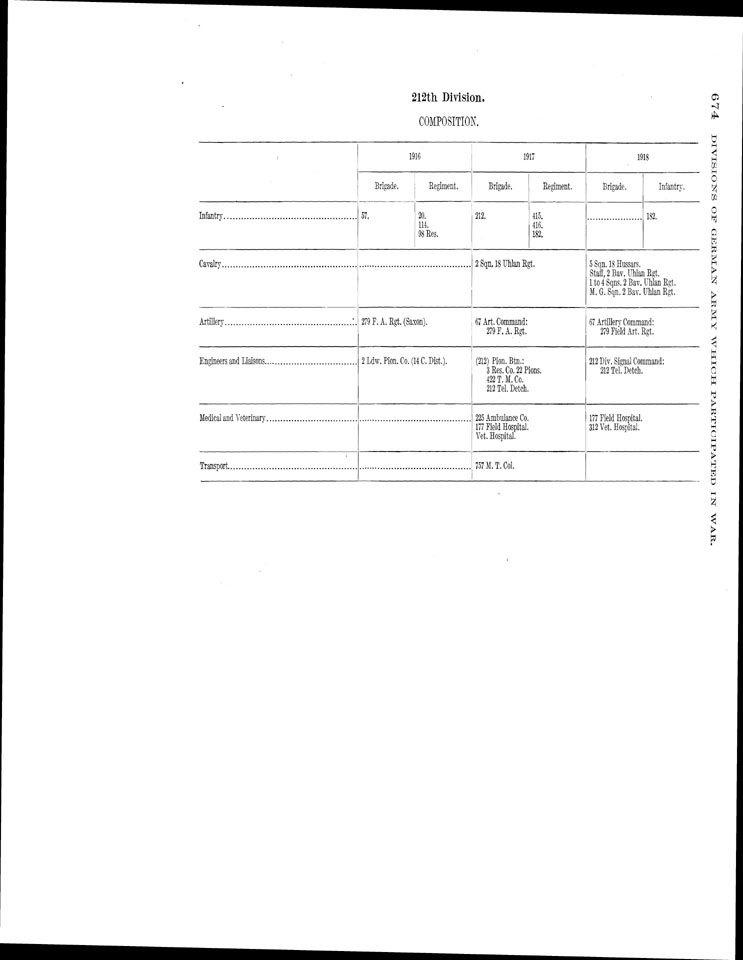
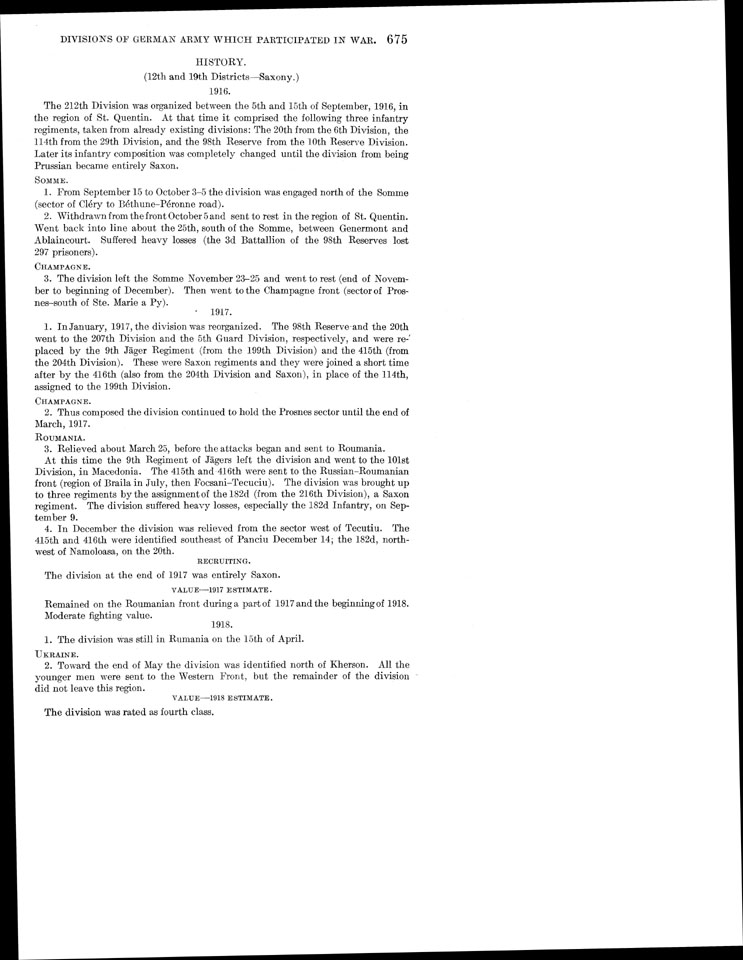
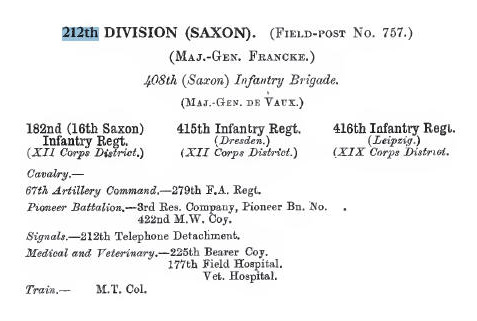
212th,13th
and of the
alpine
Corps. The
frame of the
german power
offensive is
now
complete.
The attack
of the 8th
of August
was combined
with the
attack of
the Gerock
Group, on
the
mountaineous
front of the
west ...The
attack wil
be commenced
by the 115th
german
Division,
which was
kept in
reserve, at
Faurei;
she was
elongated by
89th and
76th
divisions,
on a line
from
Ivancesti,
on Putna-the
south of
Calin
forrest, in
the Susita
elbow. The
right flank
of the
german
attack front
was defended
by the
212th
Division
along Siret,
in the
region
Ciuslea-Radulesti,
replacing
thus the
12th
bavarian
Division
which was
taken out
and brought
back to
Faureni
...
All morning
till noon,
the germans
and the
romanians
have
bombarded
each other’s
positions.
The german
bombardment
was made
with an
extraordinary
waste of
ammunition,
which made
our soldiers
to say that
they
installed
near each
battery an
ammunition
factory. On
the Romanian
Front of the
5th romanian
Division the
germans have
tried
several
attacks,
some of them
reaching our
barb wire
fence. All
of them have
been easily
rejected by
the baraj
artillery
fire and by
the machin
guns.
Especialy
has suffered
heavy losses
the infantry
of the 76th
german
Division,
which was
surprised in
open field
by the fire
of
machineguns
of the 5th
romanian
Division,
redrew on
the edge of
the Calin
Forrest.
The main
attack was
made by the
germans over
the Russian
Front, kept
by the 71st
and 13th
divisions.
The attack
given with
powerful
forces and
with a
violence
beyond say,
has defeated
the russians,
producing
them
considerable
losses. One
Russian
regiment was
almost wiped
out.
The germans
said that
only one
sanitary
company has
buried at
Patrascani
800 russian
dead bodies. The
Russians
have lost
the villages
Patrascani
and
Batinesti
and have
disorderly
retreated to
Susita.
The german
front has
advanced on
a line to
the north of
those
villages,
connecting
them to the
right, over
the railway
and
driveway,
with the
front of the
76th
austrian
Division,
from the
XVIIIth
Corps,
brought
forth by the
advancing of
the Ist
german
Corps, she
has done
progress to
Olesesti.
With this
face, the
fighting
action was
progressing
step by step
from east to
west,
transmitted
to the
sector
Wenninger
Corps, quiet
till then.
All night
between 8-9
August, the
artillery
bombardment
was very
violent
forseeing a
hard day ...
The fourth
day, 9th of
August ...
With all the
yesterday’s
succes on
the Russian
Front, the
german
commandment
has no
reason to be
pleased: the
target
proposed by
the new
offensive to
north-west
has not been
touched and
the line
Clipicesti-Diocheti
was still
far away. So
the action
wil continue
doday with
power in the
same
direction
and by the
same units,
as
yesterday,
by the
115th, 89th
and 78th
divisions,
from east to
west. In the
left of the
german
attack
sector, the
62nd
austro-hungarian
Division
will join
the fight,
as far as
the
circumstances
will permit,
and on the
right side,
the
216th german
division
will attack
the positon
occupied by
the 5th
romanian
Division.
Along Siret,
in Ciuslea
sector,
the 212th
and 303rd
german
divisions
will
maintain
their
resistance
positions,
facing east. The
main blow
will be
received by
the 71th
Russian
Division,
seated in
front of
76th and
89th german
divisions, as
well as the
13th russian
Division,
disposed in
font of the
115th german
Division and
62nd
Austrian.
The germans
were
following
consecvent
their tactic
program:
attacking
only the
Russian
troops ...
The germans
have
prepeared
the today
attack, by a
long(time)
bombardment
of the
romanian-russian
positions
...At 6:30
in the
evening, the
german
artillery is
extending
its aiming,
and the
attack waves
of the 76th
german
Division
starts
towards the
positions
occupied by
Russians in
the eve. To
their
surprise,
instead of
Russians,
ready to run
away,
the germans are
greeted by
the
Romanians,
which resist
with manhood
and
counterattack
with vigour.
The Romanian
artillery
opens, to
its turn,a
baraj fire
very well
aimed, and
the
machineguns
crops the
terrain in
front of the
lines. The
upwind of
the enemy is
drowned in
its own
blood and
the broken
and rared
raws are
getting to a
stop. The
germans are
always
changing the
palce of the
attack ...
All the gain
made by the
germns, with
heavy
losses, is
now lost.
Towards
east, the
artillery on
the left
shore of
Siret
violently
bombards in
flank the
german
lines,
making big
losses to
216th, 212th
and 303rd
divisions.
At the
center, in
the middle
of the duel
of the two
artilleries
adversary,
which does
not weakens
the
strength,
german
troops
attack the
front ...The
commander of
the Romanian
battalion
takes
measures for
defence, by
rising a
wall of dead
bodies in
the driveway
trench;
the germans
ar doing the
same on the
other side
and,
sheltered by
this double
dead bodies
wall
...
In
the russian
sector, the
right wing
of the 89th
german
Division,
taken in to
flank by the
artillery of
the 9th
Romanian
Division,
had big
losses and
realized
small
progress. To
the west
,the germans,
encountering
...
The fith
day, 10th of
August ...
From the
intact
german
lines,
undestroyed
by the
artillery
fire, which
was not
enough, the
enemy
prepeared
for attack,
waves down
fires over
the braves
that are
advancing to
attack ...
The assault
troop has
remained all
night to
guard before
the enemy
barb wire
nets,
as a symbol
of
fulfilling
the duty,
beyond
death….West
of the
railway, in
the russian
sector,
the germans
continued to
unfold their
offensive
action
started in
the eve.
They have
rejected on
a large
front the
troops of
the 71st
russian
Division -
which have
fought badly
- and they
pushed the
front line,
in the shape
of an angle,
in the depth
of the
russian
positions.,
crossing
over Susita.
Hung by the
german
advance,
the 62nd
austro-hungaran
Division was
advancing as
well,
almost
without
will, thus
occupying
the villages
Oltesti and
Tifesti,
left by the
russians. In
the
afternoon
however, the
russians
started a
counterattack
from the
direction of
Poiana, with
four
battalions
of the 13th
Division.
The
austrians
have given
thus to the
Russians the
possibility
of a cheap
success;
they quickly
withdrew
from the
conquered
positions; a
whole
regiment
have given
up their
weapons
double-crossing
thus to the
enemy,
together
with all
their
material
(military
gear)
The german
troops of
the alpine
Corps,
situated in
reserve near
the front
line,
together
with the
left wing of
the 115th
german
neighbor
Division,
intervine
into the
fight and
retake the
position
lost by the
austrians.
The fifth
day of the
great battle
was one of
the
bloodiest.
On the
romanian
battlefield,a
small
success,
payed dearly
with great
martyr. But
also the
adversary
had to pay
expensive
for his
resistance:
the 89th
german
Division,
which was in
front of the 5th
romanian
Division, had
big
casualties.
Overcome
with
exhaust,driven
to half of
its
effectives,
had to be
drawn out of
the fight
and brought
behind the
front, at
Ivancesti,
for rest and
recovery.
On the
russian
front
however,
the germans
have made a
felt
success;
they have
pushed north
the
frontline,
constituting
a serious
threat for
the romanian
flank and a
joyful hope
for the
germans. The
unfolding of
the next day
action will
be made by
exploiting
this
situation
...
The Sixth
day, 11th of
August
...
The
offensive
action wil
be given on
the whole
front of 5th
and 9th
Divisions, with
the
involvement
of the
Russian
divisions
from the
right. As
the Romanian
command was
taking
measures ,the
german
commandment,
was
measuring
himself for
a great
offensive
which he has
also planned
for the same
day. Under
the
impression
of the
success
obtained
yesterday on
the Russian
front,
Mackensen
was sure
that he will
be able to
give today a
major blow.
This was
supposed to
be made out
of two
attacks: one
attack wil
be given at
the left
side of the
IXth german
Army, in the
sector of
XVIIIth
Wenninger
Corps, which
was inactive
up until
now. The
concentrations
of forces of
this Corps
was now
complete.
The Alpine
Corps was
now in
position,
over imposed
between 62nd
Austrian
Division,
which has
gathered her
front-
and 115th
German
Division.
The
13th
Austrian
Division was
in the Corps
reserve,
and the
217th
Division was
taken from
Gallawitz
Army, and
passed under
the orders
of XVIIIth
Corps.
Wenninger
wil attack
with the
Alpine
Corps,
leaned on
the right,
by 1st
german
Corps:
Morgen will
attack wit
76th and
12th
Bavarian
Divisions -
the las one
taken again
into front,
after rest
and
recovery. He
will hit the
Russian
troops, made
out from the
remains of
the 71st and
34th
Divisions,
along the
driveway and
railway
Focsani-Marasesti-Adjud,in
the right
flank of the
9th Romanian
Division. So
,a double
offensive,
both hitting
the Russian
troops. The
day of 11th
August was
announced to
be a bloody
one, filled
with high
hopes, both
sides. The
German
offensive
has started
in the
morning in
Wenninger
sector. The
Alpine Corps
attacks fith
full
strength the
15th Russian
Division,
assaulting
Poiana
village,
advancing
all the way
in to Susita
valley. At
the left the
Austrians
have
occupied the
village Sirb.
The German
front has
made in this
way an
important
advance; he
mastered
Susita
valley,Putna
valley up to
Vitanesti....
The Germans
confess that
their
divisions,
216th
and 76th
have sufferd
this day
great
losses,
because of
the Romanian
artillery
fire on the
eastern
shore of
Siret river
....
The 7th and
the 8th days
of battle
12th -13th
of August.
Changes in
the Romanian
Command.
During the
night of
11th -12th
of August
on the left
shore of
Siret river,
in front of
the
212th
and 303rd
German
Divisions.
...
The German
commander
took fight
dispositions
for the day
of 12th of
August. In
the wave of
the heavy
fights in
the eve, the
offensive
force of
Morgen’s
Corps has
weakened. On
the other
hand, the
idea that
only on the
Russian
front it is
possible to
obtain an
important
success, was
stronger.
Von Eben was
ordered to
suspent the
action
against the
Romanians
and to aim
his attacks
with full
strength
against
VIIIth
Russian
Corps,
moving the
action west,
in the
region of
Panciu. The
Alpine
Corps, new
elite and
fresh unit,
has ben
intercalated
in the
VIIIth
German Corps
.General von
Wenninger
will retake
the
offensive
with a group
made out in
the center
by the
Alpine
Corps,
sustained on
the right by
115th German
Division,a
nd on the
left by the
62nd
Austrian
Division and
by the
Galwitz
Group. The
action will
evolve
together
with Gerock
Group,from
the Rohr
Army ,in
Oituz
valley.
In two days
of fights,
the Germans,
attacking
the Russian
forces which
were weak
resisting,
have made
quick
progresses
and
conquered
one after
the other a
multitude of
localities.
Satu Nou
(The New
Village),
Crucea de
Jos (The
Lower
Cross),
Dumbrava (Smallforest),
Valeni (like
valley but
masculine
gender…),
Clipicesti(wink-ing),
Burca, have
been
occupied at
12th of
August.
Tirgusorul –Panciu,Crucea
de Sus and
Serbesti
have been
occupied in
the morning
of 13th of
August. The
115th German
Division,
looking to
enlarge her
front, at
the right
wing,c ame
into contact
with the
13th
Romanian
Division,
which
occupied the
ex-sector of
the VIIth
Russian
Corps, and
had to stop
there. In
this way,
the Germans
have managed
to conquer
the lines of
the heights
which
dominate
Susita
Valley.from
the north.
The whole
Russian
front, till
Iresti was
shaken and
pushed back.
The Germans
were in
front of the
hills of
Iresti,
Muncelului,
Straoanelor
and
Minastioarei,
making in
the depth of
the Russian
positions a
big entering
angle. From
here, they
were
threatening
the whole
flank of the
Romanian
line from
the east, to
Siret river.
On the
Romanian
front of the
Vth Army
Corps, the
counteroffensive
given on
days 10th
and 11th of
August, have
not been
pursued
because, if
the 13th
Division,
fresh and
intact unit,
was able to
fight the
enemy, the
9th Division
was
completely
exhausted
and
incapable to
make an
offensive
gesture.
Thus, it was
renounced
whatever
velleity of
counteroffensive
and was
decided to
proceed to
fill in the
blanks and
and organize
the
defensive of
the new
positions.
The Germans
have given
in these
days, small
attack of
fixation,
sometimes
with big
patrols,
sustained by
artillery,
to distract
one’s
attention
from the
principal
action given
on the front
of the
VIIIth
Russian
Corps. They
have all
been
rejected by
artillery
fire and
machineguns.
The
strongest
attack was
made on 12th
of August on
the front of
the 13th
Division; it
was
brilliantly
rejected by
a
counterattack
of the 50th
Infantry
Regiment,
which made
the enemy
run away
making
bloody
losses, of
around
200-300 men,
gaining 200
meters of
terrain in
depth ...
The 9th
day,14th of
August
The attack
of the
XVIIIth
German Corps
was given
against the
sector
occupied by
the VIIIth
Russian
Corps, in
the Panciu
region ...
The German
Alpineers,
starting
from
Straoane de
Jos,Crucea
de Sus,
Panciu si
Crucea de
Jos, haste
to attack at
the Russian
troops on
Chicera Hill
...
The Germans
have
concentrated
against the
Romanian
position of
Prisaca
Forest the
whole
216th
Division,
which has
been given
to dispose
of a very
powerful
artillery of
all
calibers,
especially a
lot of heavy
artillery.
The
bombardment
have started
during the
previous
night and
continued
all morning.
In the
afternoon it
has reached
an intensity
almost
unknown till
then. Shells
of big
caliber
,especially
150 mm,
explosives
mines,
bombards,
grenades,
shrapnels,
are beating
like
stonerain
over the
defensive
workings.
The terrain
being weak
in this
sandy field
of Siret
River, the
works are
easily
destroyed.
The sticks
of the wire
nets are
pulled
altogether,
the trenches
are undone,
burring
alive the
defenders.
Clouds of
smoke, of
axfixiant
gas and tear
gas unfolds
then
everything
in thick
veil black-redish.
It is
complete
blackness.
It is an
Inferno. At
5 in the
afternoon
the
bombardment
has reached
paroxysm.
Their
effects are
crushing.
The entires
of the first
and the
second
Romanian
defensive
lines does
not exist
anymore; the
strongholds
of the third
line are
turned over
as well. The
phone lines,
between
battalions,
artillery
and
commandments
are
destroyed.
The soldiers
in the
trenches are
killed by
bombardment
or
axfixiated
by gas and
covered by
the blowing
Earth. The
enemy
artillery is
elongating
its aiming;
She hits
Cosmesti
village, the
bridge over
Siret and
the opposite
shore, to
stop any
attempt of
help. A
cloud of
axfixiant
gas is waved
down over
the
artillery of
the 14th
Division;
all servants
of a battery
(four
cannons) are
out of
service. At
7:45 in the
evening
,under the
protection
of a cloud
of dust and
smoke, the
Germans are
beginning
their
attack. One
column, in
the power of
almost two
regiments,
attacks in
the
connection
point of 8th
and 9th
Romanian
Regiments.
The
defenders
are few and
weak. It is
the 9th day
since the
5th Romanian
Division is
in the first
line of
fire,
receiving
blow after
blow; the
effectives
of the
Division are
reduced at
one third of
what was in
the
beginning,
and the man
,
unexchanged,
are torn
with exhaust
at body and
soul. The
strongholds
workings,
destroyed
cannot
oppose any
resistance;
the soldiers
of the Ist
Battalion of
the 8yh
Regiment are
pushed back
and the
front is
broken.
The enemy
flow is
pouring more
and more and
the breach
is widened
.The Germans
open in
three
columns: one
towards the
left ...
This
resistance,
united with
the cover of
darkness
which was
falling in
the mean
time, on the
battlefields
stops the
Germans on
the spot.
They try
during the
night three
attacks,
which are
rejected and
the fight
ends. The
big attack
enterprised
by the
Germans
against the
“bridge
head” at
Baltareti-Cosmesti,
has succeded
in part. The
Prisaca
Forest has
fallen into
their hands;
the 5th
Division was
destroyed.
The Germans
say they
have
captured
almost 3000
prisoners,
16 cannons
and 40
machine guns
...
From the
10th till
the 13th
day,
15th-18th of
August.
In the day
of 15th of
August,
Weninger
attacks with
his left the
VIIIth
Russian
Corps, at
the union
point of
Divisions
15th and
103rd,south
–est of
Muncelu,
after
preparations
of artillery
and
axfixiant
gas. ... The
German
Alpiners
have
occupied
Stranoare,
Muncelul and
are
advancing
towards
Mingalaicu.
he German
front has
taken here
the form of
a great
angle ...
The advance
of the
Germans in
Muncelul
region
...The
advance of
the German
troops in
Muncelul
region has
worsen
things
further
...he is
thus
intercepting
the
direction of
advancing of
the Germans
towards
north-west,
along Susita
...
The big
German
Headquarter
gives the
green light
,and decided
to give at
19th of
August a
double blow:
one violent
offensive at
Marasesti
and an
attack on
Trotus
front. The
combined
action of
Mackensen
armies and
Rhor must,
in the
conception
of the enemy
commander,
give the
decisive
victory, so
long waited
...
Mackensen
has choose
for applying
the decisive
blow,
the Romanian
portion of
front
between
Panciu and
Marasesti.
The position
was occupied
in this
sector by
13th
Romanian
Division and
what was
left from
the heavy
trialed 9th
Division. On
the map it
draws an
oblique line
north-west-south
–east,
stretched
from east of
Dumbrava
Village,
where it was
connected
with the
10th
Division,
passing then
south-west
of the
Razoare
Forest,
cutting the
railway
Marasesti-Panciu
close to the
height point
100,cutting
the railways
Focsani-Marasesti
and
Marasesti-Tecuci
one half
kilometer
south of the
Fabrica de
Zahar(sugar
factory) to
link with
the 14th
Romanian
Division
near an arm
of Siret
River, one
km or so
further
fromn the
estern
corner of
Marasesti
Village .
In this
sector,
Mackensen
proceeded in
the days of
17th-18th of
August to a
new grouping
of forces of
infantry and
artillery.
Five
infantry
Divisions
have
constituted
the attack
group, which
command has
been given
to Commander
von Morgen.
It was
,starting
from north
–west
towards
south-east,
the 13th
Austro-Hungarian
Division, in
the right
angle of the
railway
Marasesti-Panciu;
The 115th
German
Division ,
in
continuation,
south –east
of the first
one; the
76th German
Division ,
south of
Marasesti;
in reserve
has been
brought the
89th German
Division and
set behind
115th and
12th
Divisions.I
n the left
side of the
attack group
was XVIIIth
German
Corps; at
the right
Divisions
216th, 212th
and
303rd;they
will sustain
with all
their
infantry and
artillery
the primer
blow, which
will be
given by the
attack
group. The
five
Divisions of
this, aimed
against two
Romanian
Divisions
were making,
of course ,
a crushing
superiority.
The Marshall
was sure
that the day
of 19th will
bring him
the so long
waited
success ...
A hot summer
day was
forseen for
the 19th of
August,
morning ...
The 9th
Romanian
Division was
attacked by
the right
half of the
12th
Bavarian
Division and
almost the
entire 76th
German
Division; he
right wing
of this
division has
also
attacked the
right of the
14th
Romanian
Division ...
All over the
place, the
advancing of
the Germans,
in the empty
terrain in
front
of the 9th
Hunters
Regiment is
stopped at
3-400 meters
before the
front line.
The attack
is then
going at the
two wings of
the Hunters
line, where
the
Negroponte
grape
growing of
the right
flank and
the corn
uncut of the
left flank ,
in front of
the 40th
Regiment,
give to the
Germans the
possibility
to sneak
through the
connecting
places with
the neighbor
regiments:
with 50th of
the 13th
Division and
with
Regiment
40th.
The wing
companies
are strongly
attacked by
the flanks
by the enemy
much
superior.
The Hunters
see for the
first time
the Germans
with their
metallic
assault
helmets;
mislead by
the
resemblance,
they take
them as
Romanians
with French
helmets and
let them
close the
trenches.
then
,attacked
from very
close,
beginning to
receive
machine gun
fire from
the back,
where the
enemy
managed to
sneak, the
companies do
not resist
for long and
break.
The
Hunters are
making
efforts to
keep the
factory.
Beat
infernal by
the enemy
artillery,
the walls of
the factory
are tore
down, making
a big noise
under the
blows of
projectiles
of big
caliber. A
furious
fight with
grenades and
bayonet is
starting
,between the
smoking
ruins of the
big Sugar
Factory
(Fabrica de
Zahar) The
enemy
cannons
execute a
baraj firing
range behind
the factory;
a handful of
men can
sneak
through the
baraj line.
The rest o
those living
are made
prisoners.
At 10:15 the
first line
and the
factory are
in the hands
of Germans
...
The front of
the 13th
Division has
been
attacked by
a powerful
enemy, by
two
Divisions as
such :the
50th
Regiment has
been
attacked by
the left
wing of the
12th
Bavarian
Division,
the 51st
Regiment
has been
attacked by
the 115th
German
Division,
and the 47th
Regiment by
the right
half of the
13th
Austro-Hungarian
Division
.Between
clocks 9 and
10 in the
morning the
attack over
the German
infantry
over the
Romanian
line has
become
generalized
,
as the enemy
artillery is
concentrating
its fires
especially
over the
eastern side
of the
forest “La
Razoare”.
The
Romanian-Russian
artillery is
firing with
precision
over the
enemy waves;
the
artillery of
the neighbor
Division,
the
10th,takes
part in the
fight,
firing
oblique over
the enemy
masses which
were
attacking
the 13th
Division.
But the
enemy has a
crushing
superiority
of forces.
He doesen’t
care about
losses,
because
today and in
this sector
he is
looking for
the
decisive.
Over the
fallen rows
, others
pass.
Stepping
over the
dead bodies
over their
fight
colleague,
fallen, the
enemy rows
reach the
Romanian
line, which
has been
pulverized
by the
artillery
firing
range,
breaks the
Romanian
rows and
throw them
backwards
...
While the
51st
Regiment was
heroic
sustaining
the fight
against the
masses of
the 115th
German
Division
troops ...
The attack
of the
Austrian
Division was
given weak
and late,
compared
with the
attack of
the neighbor
115th German
Division.
Until 11
clocks, the
enemy is
satisfied to
attack only
with
patrols,
which were
crushed with
gun shots
and
machinegun
fire .The
assault
waves begun
to show
after 11
hour ...
The German
soldiers,
demoralized,
start to run
through the
forest,
throwing
away their
metal
helmets and
rifles,
pursued with
fury by the
Romanians
.The
counterattack
was a
success ...
The Germans
are
retreating
precipitated
towards
Susita
Valley,leaving
in the hands
of our
soldiers,
prisoners,
machineguns,
ammunition
and
equipment
...
On the other
hand, at the
south of the
enemy
front-were
announced
important
movements of
troops. The
units of the
89th German
Division-reserves-where
approaching
the theater
of battle to
replace the
defeated
troops. So
the
Commander of
the Army
advice the
Division
Commanders
to prudent
moves, and
to be
thankful to
reoccupy the
old
trenches,
keeping the
Divisions
reserves
intact for
any
eventuality
...
The German
commandment
has been
deeply
impressed of
the great
failure of
this day, in
which he put
all his
hope. He was
conscious
that this
was the last
effort,
which he
could muster
for winning
the victory,
in what the
Germans
called the
battle of
breakthrough
on Putna and
Susita. The
failure of
19th of
August was
putting to
an end to
the chain of
efforts of
which the
IXth German
Army made
for 14 days,
with the
price of
immense
losses; she
proved the
impossibility
of breaking
the Romanian
wall thus
sealing the
German
defeat. The
continuing
of the
German
offensive
was
impossible.
General von
Eben the
commander of
the IXth
Army, is
forced to
knowledge
this
impossibility,and
to express
in covered
words the
renunciation
:”Because to
put in order
of the units
and a pause
of the
troops shows
absolutely
necessary
and because,
in the wake
of heavy
fights, the
infantry
effectives
have
diminished,
a
continuation
of the
offensive
cannot be
conciliated
,thus, it is
ordered that
for the time
being to
fortify and
keep the
conquered
positions”.
Dry words
,official
style, which
meant
nevertheless,
the ending
of the great
battle of
Marasesti,
by
confessing
the defeat,
arrived from
the most
qualified
character to
do it ...
The forces
put into the
fight by the
Germans, 12
infantry
divisions,
where to the
height of
the expected
results from
the big
action,
which was
”the battle
of breaking
through on
Putna and
Susita”.
With all
this
imposant
unfolding of
forces, with
all the
blood
sacrifices
imposed to
the troops,
which had so
grave losses
, such as,
some
divisions
were almost
exterminated
as combative
power, still
none of the
goals hasn’
t been
accomplished,
by far. The
only result
obtained
after 14
days of
heavy
battles, was
that the
German front
line has
been pushed
with 6-7km
further
,meaning
that from
Putna shore
it was moved
on the
heights
between
Susita
Valley and
Zabrautu
Valley. And
this result
was obtained
only due to
the weakness
of the
Russian
troops
-which on
the whole
stretch of
the front
line of
battle, have
received the
first hits-
their
disgust for
war ,their
wish to put
an end to
it, even
with the
price of
shameful
defeat Only
the
substitution
in time of
the Russian
troops by
Romanian
troops has
made
possible to
stop the
fatal ending
and to
transform
the German
victory,
which seemed
a sure
thing, in a
complete
defeat ...
The battle
has begun at
6th of
August by
attacking
the front,
made
exclusively
by Russian
troops. The
Russian
position of
Iresti to
Siret River,
which
constituted
the fighting
zone itself,
was occupied
by three
Russian
divisions The
Austro
Germans were
opposing, on
the same
stretch,
seven
divisions.
In the
attack zone,
between
Siret and
the railway,
three German
Divisions-76th,
216th
and 12th
have
attacked the
34th Russian
Division.
The
unfolding of
the battle
constituted
then a
double
manoeuvre
.On one
side, the
Germans
have
stretched ,
step by step
the fighting
zone
westward,
until the
Muncelu
plateau , in
constant
search of
points of
lesser
resistance,
represented
by the
Russian
sectors ...
In the same
day the
German front
was
constituted
by the
Divisions
126th,76th,12th
Bavarian,
115th,
13th
Austro-Hungarian,
Alpine Corps,
62nd
Austro-Hungarian
Division and
Galwitz
Group, of
the strength
of one and a
half
division.
This without
taking into
account the
divisions
along Siret
River on
both shores;
one and a
half Cavalry
Division, on
the Romanian
side and
two
divisions of
infantry, on
the German
side ...
The
Battle
of
Marasesti
in
Romania
6-19
August
1917
from The
War for
Wholing
Romania
1916-1919
by
Constantin
Kiritescu
-
http://1914-1918.invisionzone.com/forums/index.php?showtopic=116534
(c. Late August - Early September)

.jpg)

.jpg)
.jpg)